

Our Sun, A Volatile Star
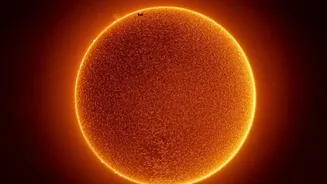
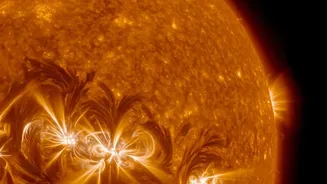
The Sun, the life-giving star at the center of our solar system, has a temper. It constantly sends a stream of charged particles, known as the solar wind, hurtling into space. Most of the time, this is harmless, but sometimes, the Sun unleashes more violent
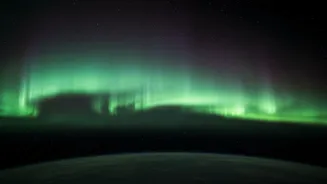
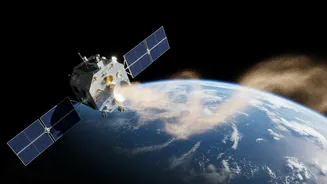
eruptions: solar flares and coronal mass ejections (CMEs). These events blast enormous clouds of plasma and radiation into space. If Earth is in the crosshairs, the consequences can be severe. These solar storms can disrupt our planet's magnetic field, inducing powerful electrical currents on the ground. The results can range from interference with GPS and radio communications to widespread power blackouts and permanent damage to critical transformers. In an increasingly connected and technology-dependent society, our vulnerability to this space weather is greater than ever.
Introducing IMAP: A New Sentinel
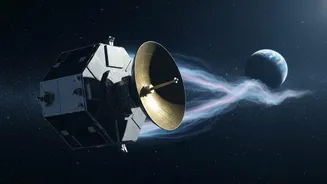
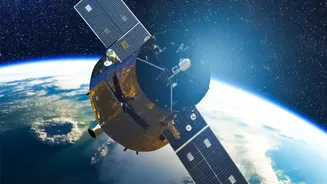
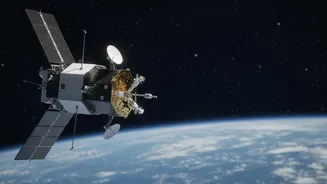
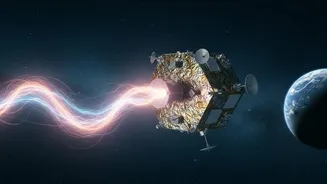
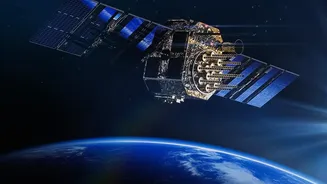
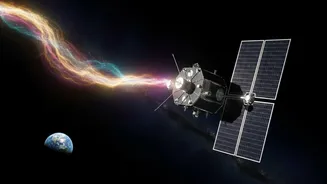
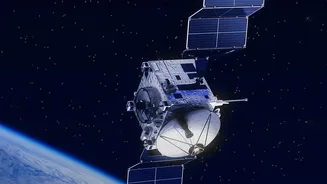
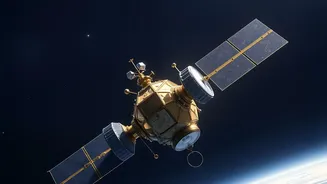
To better protect us, NASA launched the Interstellar Mapping and Acceleration Probe, or IMAP, in September 2025. After a journey of roughly 1 million miles, it has settled into a strategic orbit between the Earth and the Sun at a gravitationally stable location called Lagrange point 1 (L1). This vantage point allows IMAP to get an early look at the solar wind and any dangerous energetic particles heading our way, acting as an advanced warning system. Its primary mission is twofold: to map the boundary of our solar system's protective bubble, the heliosphere, and to provide detailed, real-time data for space weather forecasters on Earth. While previous missions have studied this region, IMAP is equipped with a suite of ten advanced instruments designed to provide a more comprehensive picture than ever before.
The Game-Changer: Near-Real-Time Data
The most significant upgrade IMAP brings to space weather forecasting is its I-ALiRT system, which stands for IMAP Active Link for Real-Time. This system continuously beams a portion of the data collected by five of its key instruments back to Earth with minimal delay. This near-real-time stream of information is a massive improvement over older missions. Forecasters now have access to higher-quality, more frequent measurements of the solar wind's speed, density, temperature, and magnetic field orientation. It also provides new data types that were not previously available in real-time, such as information on high-energy electrons and the composition of the solar wind. This allows for much more accurate and timely warnings of incoming solar disturbances, giving us a precious heads-up before a storm hits.
From 30-Minute Warning to Action
From its position at L1, IMAP can provide about a 30-minute advance warning of an incoming solar particle event or CME. While half an hour might not sound like much, it is a critical window for mitigating potential damage. Power grid operators can take preventative measures to protect their networks from damaging induced currents, such as rerouting power or taking sensitive transformers offline. Satellite operators can put their spacecraft into a safe mode to protect delicate electronics from radiation damage. Airlines can reroute flights that would otherwise pass over the poles, where the risk from solar radiation is highest during a storm. For future crewed missions to the Moon and Mars, like NASA's Artemis program, this 30-minute warning is crucial for giving astronauts time to seek shelter from harmful radiation.
A New Era of Space Weather Preparedness
As of August 2026, IMAP is fully operational, and its I-ALiRT data is being continuously transmitted for forecasters. This stream of information is revolutionizing the models used by agencies like NOAA's Space Weather Prediction Center, enabling them to issue more precise and reliable alerts. The mission isn't just about immediate warnings; its broader scientific goal of understanding the heliosphere and particle acceleration will feed into long-term improvements in our forecasting capabilities. By studying how the solar wind interacts with the interstellar medium, scientists can build better models to predict the Sun's behavior and its impact on our solar system. IMAP represents a fundamental shift from simply reacting to space weather to proactively preparing for it.