


The 'Doomsday Glacier' Explained
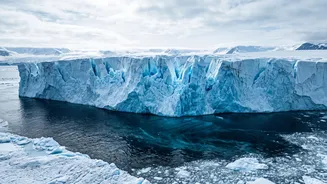
Thwaites is a colossal river of ice in West Antarctica, covering an area of 192,000 square kilometres, roughly the size of the state of Gujarat or Florida. It is called the 'Doomsday Glacier' not because its collapse is imminent, but because of the severe
consequences if it does. It currently contributes to about four percent of annual global sea-level rise. More importantly, it acts like a cork, holding back the rest of the vast West Antarctic Ice Sheet. If Thwaites were to collapse entirely, it could raise sea levels by over 65 centimetres (or two feet) on its own, and its failure could trigger a wider collapse that would lead to a catastrophic three metres (10 feet) of sea-level rise over centuries.
A Critical Weak Spot Revealed
For years, scientists have focused on the 'grounding line'—the point where the glacier lifts off the seabed and begins to float. This area is crucial for a glacier's stability. Traditionally, models have treated this as a relatively fixed boundary. However, new research shows a much more dynamic and worrying picture. A recent study published in the journal Nature Communications reveals that this isn't a simple line but a wide 'grounding zone'. High tides are physically lifting the massive ice sheet and forcing warm, salty ocean water deep underneath the glacier.
A Vast Zone of Vigorous Melting
The latest research, using satellite data, has identified a two-to-six-kilometre-wide zone where this tidal pumping occurs. Within this area, warm seawater intrudes far inland, creating channels of what scientists call 'vigorous melting'. This process was found to be happening much more aggressively than previously understood. The warm, dense saltwater pushes deep under the grounded ice, flushing out the colder freshwater melt and accelerating the erosion of the glacier's base. This means a huge area of ice that was thought to be protected is now known to be highly vulnerable to a warming ocean.
What This Means for Sea Levels
This discovery forces a major recalculation of future sea-level rise. By incorporating this widespread basal melting into their models, researchers from the University of California, Irvine, and NASA's Jet Propulsion Laboratory now project that Thwaites alone could contribute up to 30 millimetres (1.2 inches) to global sea levels by 2100. This is roughly double the amount predicted by earlier models that didn't account for this deep water intrusion. This projection holds even without any additional increase in climate warming, highlighting the sensitivity of the glacier to current conditions.
An Unstable Future
The accelerated melting at its base is also destabilizing the glacier's connection to the seafloor. Thwaites is currently partially held in place by an underwater mountain called the Mouginot Ridge, which acts as a natural brake. The new models show a 60% chance that the glacier will become unpinned from this ridge by 2100, a development that could happen as early as the late 2030s. Losing this anchor point would likely cause the glacier's retreat to speed up significantly, exposing coastlines around the world to even greater risks from rising sea levels. While the full collapse is not expected this century, these findings underscore that key processes of decay are happening faster than anticipated.