



A Portrait of Galactic Encounters
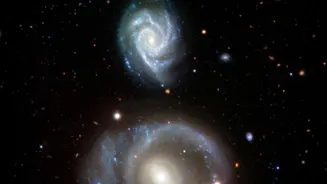
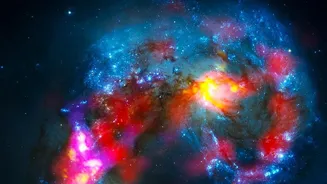
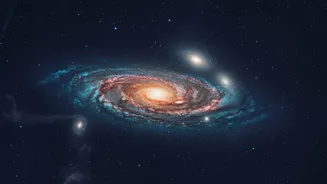
The Hubble Space Telescope has once again delivered a breathtaking snapshot of the cosmos, this time focusing on what appears to be three sets of interacting galaxies. One prominent image that captures this phenomenon is of a trio known collectively as NGC
7764A, located about 425 million light-years from Earth in the Phoenix constellation. In the image, two galaxies in the upper right seem to be stretching toward each other, their stars and gas creating luminous trails that suggest a powerful gravitational tango. A third, seemingly unrelated galaxy sits to the lower left. Images like this, which showcase multiple galaxies seemingly close together, provide astronomers with a celestial laboratory to study how galaxies evolve, merge, and grow over billions of years.
The Illusion of Proximity
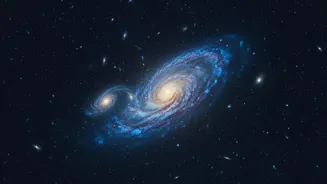
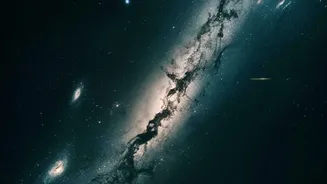
The central intrigue of this kind of image lies in a fundamental challenge of astronomy: distinguishing true companions from optical illusions. While some galaxies in the frame might be genuine interacting pairs, locked in a gravitational embrace, others are merely aligned by chance from our line of sight. For instance, in the case of the NGC 7764A group, astronomers believe the two galaxies in the upper right are indeed interacting. However, the relationship with the third galaxy is less certain; its apparent proximity could just be a coincidence of perspective. This phenomenon of “optical pairs” is common. One galaxy might be millions of light-years in the foreground, completely unrelated to another that appears right beside it but is actually far in the cosmic background. Such chance alignments highlight the sheer density of galaxies in the universe.
How Astronomers Uncover the Truth
So, how do scientists tell the difference between a true couple and cosmic photobombers? The key is measuring distance, and the primary tool for that is redshift. As the universe expands, light from distant objects gets stretched to longer, redder wavelengths. By analyzing the spectrum of light from a galaxy, astronomers can calculate its redshift and, consequently, how far away it is and how fast it’s moving away from us. If two galaxies show a similar redshift, it’s a strong indicator they are at a similar distance and could be a genuine, gravitationally bound pair. If their redshifts are wildly different, the pairing is just a line-of-sight illusion, like seeing a distant mountain peak appear to sit right on top of a nearby hill. This analysis is crucial for building accurate 3D maps of the universe.
Why These Views Matter
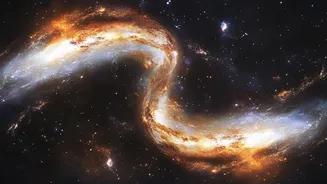
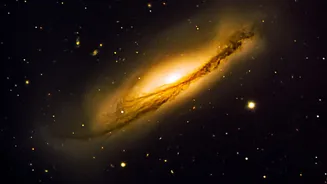
Whether they are true mergers or optical tricks, images featuring multiple galaxies are incredibly valuable. True interacting pairs, like the galactic trio SDSSCGB 10189 which are set to merge, provide direct evidence for how the largest galaxies in the universe are formed. Astronomers believe these massive systems, called Brightest Cluster Galaxies, grow by consuming other large, gas-rich galaxies over eons. On the other hand, chance alignments are also scientifically useful. When one galaxy passes in front of another, the foreground galaxy can act as a natural lens, with its gravity bending the light of the background object. This effect, known as gravitational lensing, can magnify the more distant galaxy, allowing astronomers to study it in greater detail than would otherwise be possible. These alignments also allow for unique views of the foreground galaxy, silhouetting its dark dust lanes against the light of the one behind it.