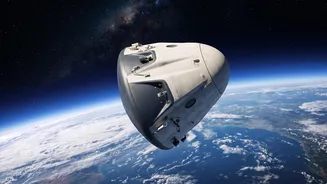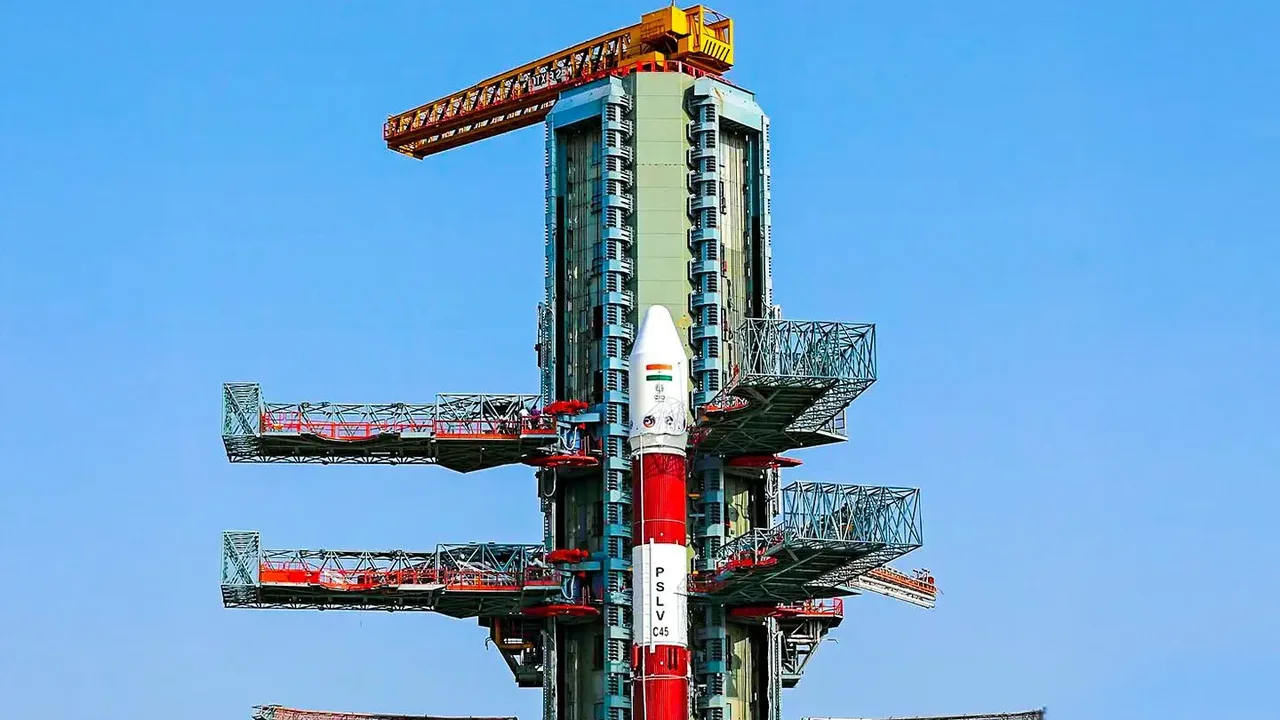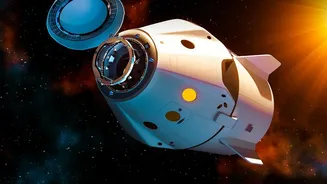






As India’s Gaganyaan mission moves closer to its historic goal of sending astronauts to space, the focus sharpens on the most critical element: crew safety. A series of meticulous qualification tests for the crew module reveals ISRO's methodical approach.
The Philosophy of Redundancy
Sending humans to space is fundamentally different from launching satellites. While every ISRO mission is a high-stakes endeavour, Gaganyaan introduces the non-negotiable element of human life. This elevates the importance of the Crew Escape System (CES), which is essentially a lifeboat for astronauts. The system is designed to quickly pull the crew module away from the main launch vehicle in case of an emergency on the launchpad or during ascent. This philosophy of building in an escape route, and then testing it relentlessly, is the bedrock of crewed spaceflight. It demonstrates a maturity that prioritizes the lives of the ‘gaganauts’ above all else, positioning India among the few nations with advanced crew safety systems. The recent push to qualify various subsystems shows a deliberate and phased approach to proving every component is ready for the immense challenge.
Test One: Abort on the Launchpad
What happens if a problem arises moments before liftoff? The Pad Abort Test (PAT) is designed to answer this question. In a successful test conducted in 2018, ISRO demonstrated this exact scenario. A test version of the crew module was propelled away from a simulated launchpad by powerful, fast-acting solid motors. The module reached an altitude of nearly 2.7 kilometres before safely deploying its parachutes and splashing down in the Bay of Bengal. This test proves the system's ability to save the crew in the most immediate of emergencies, where reaction time is measured in seconds. It validates the first and most crucial link in the safety chain, ensuring that even a catastrophic failure on the ground doesn't have to be fatal.
Test Two: Mid-Air Emergency
A launch vehicle is under maximum stress as it pushes through the dense lower atmosphere. The Test Vehicle Abort Mission-1 (TV-D1), conducted in October 2023, was designed to simulate a failure during this critical phase. A test vehicle lifted off, and at an altitude of about 17 kilometres, an in-flight abort was deliberately triggered. The Crew Escape System fired, pulling the module away from the rocket. The module then coasted to a higher altitude before beginning its descent, deploying its parachutes, and splashing down safely, where it was recovered by the Indian Navy. This complex test validated the escape system's performance at high velocity and aerodynamic pressure, proving it can function in the chaotic environment of a mid-air launch failure.
Test Three: The Final Descent
Whether returning from a successful mission or an emergency abort, the final moments of descent are critical. This is where a series of tests on the parachute and recovery systems come into play. Recent Integrated Air Drop Tests (IADT) have validated the complex parachute deployment system. In these tests, a crew module weighing the equivalent of a mission-ready capsule is dropped from a helicopter at a specific altitude to test the sequence of parachute deployment — from the initial smaller drogue chutes that stabilize the module to the large main parachutes that slow it for a soft landing. Other recent ground qualification tests have focused on ensuring the module can right itself if it lands upside down in the water, a system known as the Crew Module Up-righting System (CMUS), and verifying the structural integrity during key separation events, like when the apex cover is jettisoned to release the parachutes.