


A Groundbreaking Glimpse of the Sun
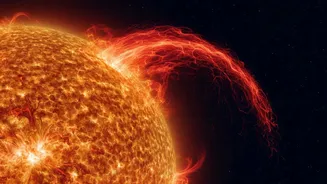
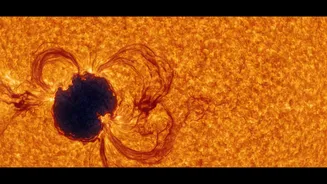
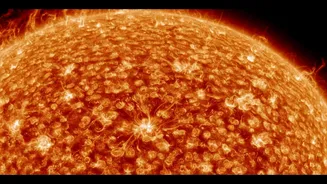
Scientists using the Daniel K. Inouye Solar Telescope in Hawaii have released the highest-resolution images of the Sun's surface, or photosphere, ever taken. These images, captured in early August 2026, show the Sun's churning plasma in incredible detail,
revealing structures as small as 12-20 kilometres across. Instead of a uniform ball of light, the surface appears as a collection of cell-like granules, each about the size of Texas, which are the tops of convection cells that carry heat from the Sun's interior. The images are so sharp they reveal strange, swirling vortices and feather-like patterns that one scientist likened to Van Gogh's 'Starry Night'.
Seeing a Long-Theorised Phenomenon
For the first time, these images have confirmed a process on the Sun's surface that scientists have long theorised but never directly observed: the Kelvin-Helmholtz instability (KHI). This phenomenon occurs when two fluids, or in this case plasmas, move past each other at different speeds, creating a shear that results in wave-like, swirling vortices. While KHI is common on Earth, seen in cloud formations and ocean waves, and on other planets like Jupiter, spotting it on the Sun's photosphere is a major breakthrough. These instabilities appear as ultra-fine dark stripes and deformed boundaries at the edges of the bright solar granules, giving scientists a new window into the Sun's magnetic activity.
Solving the Sun's Biggest Mysteries
Observing these tiny swirls is crucial because it could help solve one of solar physics' most persistent puzzles: the coronal heating problem. The Sun's outer atmosphere, the corona, is hundreds of times hotter than its surface, which defies our basic understanding of thermodynamics. Scientists have hypothesized that phenomena like KHI could be transporting enormous amounts of energy from the surface up into the corona, heating it to millions of degrees Celsius. By studying the prevalence and energy of these instabilities, researchers can now test this theory with real data, potentially explaining why the Sun's atmosphere is so inexplicably hot.
The Link to Violent Space Weather
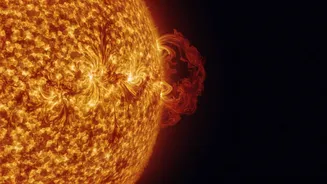
Understanding the Sun's surface isn't just an academic exercise; it has profound real-world implications. The same magnetic energy that drives phenomena like KHI is also what fuels solar flares and coronal mass ejections (CMEs). These are massive explosions on the Sun that hurl radiation and charged particles into space. When directed at Earth, this 'space weather' can have a devastating impact on our technology-dependent society. Better understanding of the small-scale processes driving these eruptions is the first step toward better predicting them.
Protecting Our Tech-Reliant World
A severe geomagnetic storm, triggered by a CME, can induce electrical currents in power grids, potentially causing widespread blackouts like the one that hit Quebec in 1989. It can also disrupt high-frequency radio communications used by aircraft and the military. Furthermore, the influx of charged particles can damage sensitive satellite electronics, interfere with GPS signals, and increase atmospheric drag on low-orbiting satellites, threatening the critical infrastructure we rely on for communication, navigation, and even banking. For a nation like India, which is rapidly expanding its digital and satellite infrastructure, the ability to forecast severe space weather is of paramount importance.