




The Unseen Art of Postural Control
Balance feels automatic, but it's a complex skill orchestrated by your brain. This is known as postural control: your body's ability to maintain its centre of gravity. It involves a constant conversation between your eyes, your inner ear's vestibular
system, and a 'sixth sense' called proprioception—your body's awareness of its position in space. Whether you're standing still (static balance) or moving (dynamic balance), these systems work together to keep you upright. Both skating and Tai Chi are excellent for honing this skill, but they approach the training from opposite ends of the spectrum.
Skating: Mastering Dynamic, Reactive Balance
Skating, whether on ice or with rollers, is an exercise in managing dynamic balance at speed. Perched on a thin blade or a line of wheels, your body is in a constant state of controlled instability. To stay upright, you must make rapid, subconscious adjustments to shifts in momentum and surface friction. This requires bending your knees to lower your centre of gravity, keeping your upper body still, and engaging your core muscles for stability. Skating powerfully develops your reactive balance—the ability to correct your position instantly to prevent a fall. It trains your nervous system to anticipate and respond to instability with lightning-fast reflexes.
Tai Chi: The Power of Slow, Deliberate Control
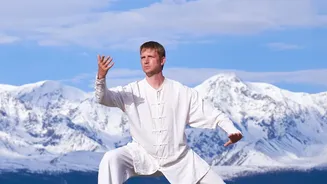
Tai Chi takes the opposite approach. Often called 'meditation in motion', its power lies in its slowness. The practice involves continuous, flowing movements where you deliberately shift your full body weight from one leg to the other. This slow, controlled weight transfer forces your neuromuscular system to make constant, minute adjustments to maintain stability. By removing the momentum that often masks poor balance during faster activities, Tai Chi compels you to become acutely aware of your posture and alignment with every single movement. This builds deep, conscious control over your centre of gravity and strengthens the small stabilising muscles in your ankles, hips, and core.
Two Paths to a Smarter Body
So, how do these different methods affect your body awareness? Skating cultivates an external, reactive sense of balance perfect for fast-paced sports and activities. Your body learns to handle unexpected changes without you having to think about it. Tai Chi, on the other hand, builds internal, deliberate control. It enhances proprioception, or your body's internal sense of itself, by forcing you to pay close attention to your movements. Numerous studies have shown that this slow-motion training is exceptionally effective at preventing falls, particularly in older adults, because it retrains the brain's ability to sense and correct instability before it becomes a problem. Some research suggests Tai Chi can reduce the risk of falls by over 40%.
Speed or Stillness: Which Is for You?
The choice between skating and Tai Chi isn't about which is superior, but which aligns with your personal fitness goals. If you're looking for a high-energy cardiovascular workout that builds agility and quick reflexes, skating is an excellent option. It’s a thrilling way to develop dynamic stability. If your priority is to reduce stress, improve mindfulness, and build foundational, conscious control over your body, Tai Chi is unparalleled. Its gentle, low-impact nature makes it accessible to people of all ages and fitness levels, offering profound benefits for both mind and body. Ultimately, the two practices are not mutually exclusive and can even complement each other, offering a well-rounded approach to mastering the art of balance.