





Our Sun’s Protective Shield
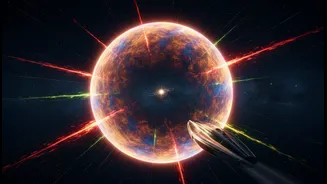
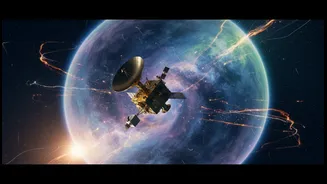
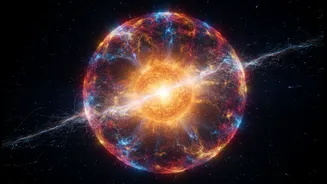
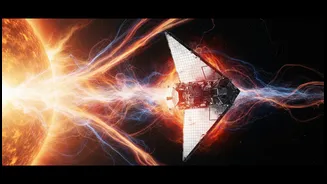
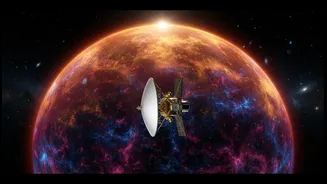
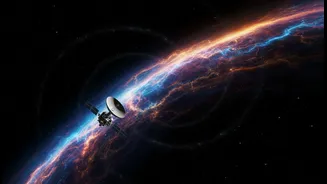
Imagine the Sun not just as a source of light and heat, but as the engine of a colossal bubble that envelops all the planets, including our own. This bubble is called the heliosphere, and it's formed by a constant stream of charged particles known as the solar
wind. This wind travels outward at immense speeds, pushing back against the material that fills the space between stars. In essence, the heliosphere is the domain of our Sun's influence. It acts as a crucial shield, protecting Earth and the other planets from a significant amount of harsh galactic cosmic radiation that originates from elsewhere in the Milky Way. Without this protective bubble, life on Earth might have evolved very differently, if at all.
The Interstellar Ocean
So, what lies beyond this solar bubble? It's not an empty void but a complex environment known as the local interstellar medium. This is the gas, dust, and plasma that permeates the space between star systems within our galaxy. The heliosphere is constantly moving through this interstellar ocean as our Sun orbits the center of the Milky Way. The boundary where the outward pressure of the solar wind balances the inward pressure of the interstellar medium is called the heliopause. This is the true edge of our solar system's immediate environment. For decades, scientists have theorized about this boundary, but sending probes to study it directly is an immense challenge.
A New Celestial Cartographer
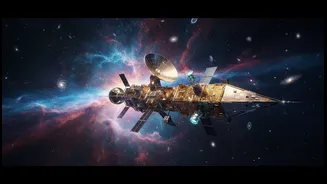
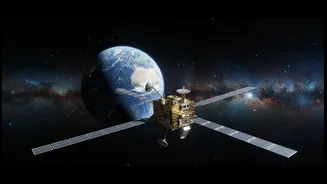
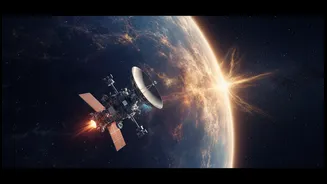
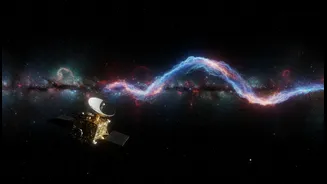
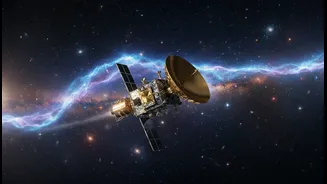
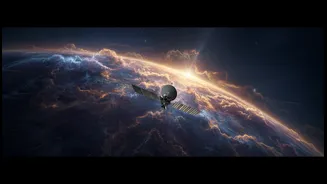
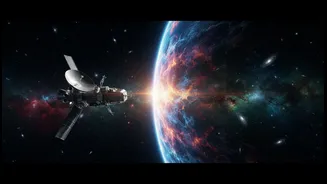
While the Voyager 1 and 2 spacecraft famously crossed the heliopause and entered interstellar space, they only provided data from two specific points. To get the full picture, we need to map the entire boundary. This is where NASA's Interstellar Mapping and Acceleration Probe (IMAP) comes in. Scheduled to launch in 2025, IMAP is designed to be a definitive map-maker for this distant frontier. From a special vantage point about 1.5 million kilometers from Earth, IMAP will use ten scientific instruments to observe particles that come from the edge of the heliosphere and deep space. This will allow scientists to create the first comprehensive global maps of this crucial boundary.
What We Hope to Learn
IMAP's primary goal is to understand the fundamental interaction between the solar wind and the interstellar medium. How does our heliosphere protect us from galactic cosmic rays? How does the interstellar material shape our solar bubble? The mission's instruments will measure the streams of particles, magnetic fields, and interstellar dust to answer these questions. Building on the work of previous missions like IBEX and the Voyager probes, IMAP will give us a dynamic, 3D view of how this cosmic shield works and evolves with the Sun's own activity cycle.
Why This Journey Matters
Beyond pure scientific curiosity, IMAP's work has practical applications. The mission will also provide real-time data on the solar wind before it reaches Earth, acting as an advanced space weather forecast station. This can give about a half-hour warning for potentially hazardous solar events that could disrupt satellites, power grids, and endanger astronauts. By charting the boundaries of our home in space, IMAP not only helps us understand our place in the galaxy but also provides vital information to protect our technology and future space explorers as humanity ventures farther from Earth.