

A New Era of Solar Sight
Our understanding of the sun is getting a major upgrade. While the headline points to a singular achievement in visible-light imaging, the reality is a broader, multi-faceted effort by NASA and its partners to see the sun as never before. Recently, the National
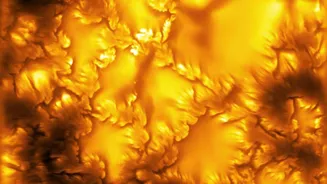
Science Foundation's Daniel K. Inouye Solar Telescope produced what is being called the highest-resolution image of the sun's surface in visible light. These images have revealed complex, city-sized details and confirmed the existence of a long-theorized process called the Kelvin-Helmholtz instability, where streams of solar plasma create wave-like swirls. This ground-based achievement is part of a larger story, complementing a new generation of space-based NASA missions designed to probe the sun's most enigmatic regions and behaviours.
NASA's MUSE: A Window into the Corona
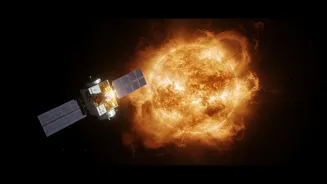
One of NASA's most anticipated solar missions is the Multi-slit Solar Explorer, or MUSE. Scheduled to launch around 2027, MUSE has a specific and challenging goal: to understand why the sun's outer atmosphere, the corona, is millions of degrees hotter than its surface. This has been one of the biggest puzzles in solar physics for decades. MUSE will not be observing in visible light, but in the extreme ultraviolet (EUV) spectrum. Its key innovation is a multi-slit spectrograph, an instrument that can observe the sun through 35 different 'windows' simultaneously. This allows it to capture data on the evolution of solar flares and other eruptions up to 100 times faster than previous instruments, providing unprecedented detail on the forces that drive solar activity. The mission recently passed a critical design review, moving it closer to its 2027 launch target.
HelioSwarm: Untangling the Solar Wind
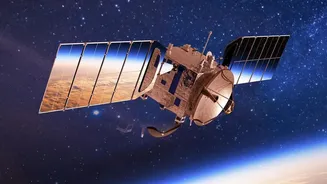
Working in concert with missions like MUSE will be HelioSwarm, another innovative NASA project selected alongside it. Instead of one spacecraft, HelioSwarm is a constellation of nine: one central 'hub' and eight smaller 'node' satellites that will fly in formation. Launching around 2028, its purpose is to study solar wind turbulence. The solar wind is a constant stream of charged particles flowing from the sun, and understanding its chaotic, multi-scale nature is crucial. By using nine spacecraft to take simultaneous measurements from different points in space, HelioSwarm will create the first-ever 3D view of this turbulence, revealing how energy moves through the solar system. This approach overcomes the limitations of single-spacecraft missions, which can only provide a one-dimensional snapshot.
Why Sharper Images Matter for Earth
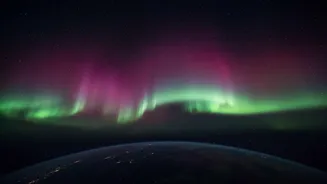
This new generation of solar observation isn't just about taking beautiful pictures; it has profound implications for life on Earth. The solar flares, coronal mass ejections (CMEs), and turbulent solar wind that MUSE and HelioSwarm are designed to study are the primary components of 'space weather'. A major solar storm can disrupt our satellite-based technologies, including GPS and communications systems, pose a danger to astronauts in orbit, and even knock out power grids on the ground. By gaining a deeper understanding of the physics that drive these events, scientists hope to dramatically improve our ability to forecast space weather. Better forecasting gives operators time to protect satellites and stabilize electrical grids, mitigating the worst effects of a solar storm. These missions are a critical investment in protecting our increasingly tech-dependent world.