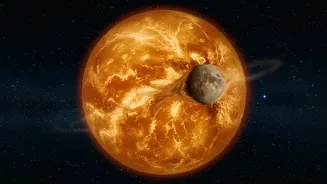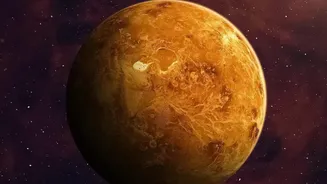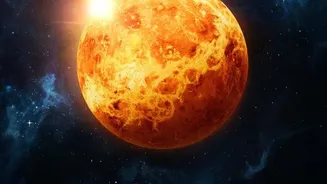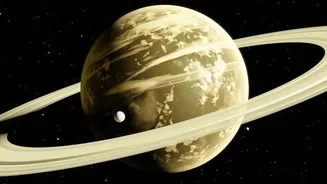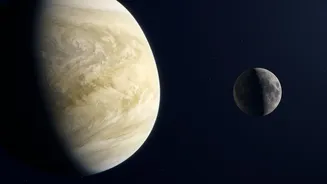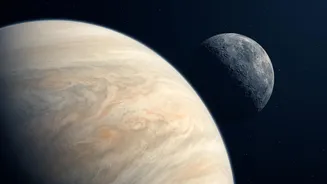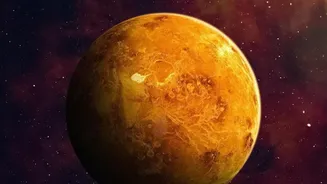



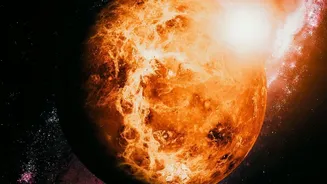
Venus is often called Earth’s twin, but it has one glaring difference: a complete lack of moons. For years, scientists have wondered why. Now, new research suggests Venus didn't just lose a moon—it may have swallowed it whole.
The Mystery of the Missing Moon
Venus and Earth are remarkably
similar in size, mass, and composition, leading scientists to believe they had similar origins. The prevailing theory for how Earth got its moon involves a giant impact with a Mars-sized object early in our solar system's history, creating a debris disk that eventually coalesced into the satellite we see today. It’s plausible that Venus experienced a similar moon-forming impact. So, where is its moon? Previous theories proposed that another catastrophic impact might have obliterated it, or perhaps Venus was just unlucky and never had a moon-forming collision in the first place. But a recent study offers a less dramatic, yet more chilling, possibility that relies not on an external catastrophe, but on the planet’s own peculiar physics.
A Planet Spinning the Wrong Way
To understand how Venus could have destroyed its own moon, we first have to appreciate how bizarrely it spins. Unlike nearly every other planet in the solar system, Venus rotates backward (retrograde), meaning the sun rises in the west and sets in the east. It also spins incredibly slowly; a single day on Venus lasts 243 Earth days, which is longer than its 225-day year. This sluggish rotation is the key to the mystery. On Earth, our relatively fast 24-hour rotation creates tidal forces that transfer energy to the Moon, causing it to gradually drift about four centimeters farther away from us each year. This process also slows Earth's rotation ever so slightly. If Venus once spun faster, it likely would have pushed its moon away, too.
The Simulation's Grim Revelation
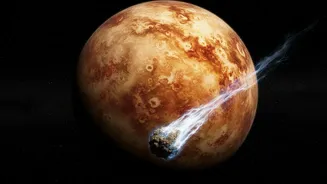
New computer simulations led by astrophysicist Stephen Kane at the University of California, Riverside, explored what would happen to a hypothetical moon orbiting Venus under various conditions. By modeling different initial rotation speeds for Venus and different masses for its moon, the researchers discovered a consistent and destructive pattern. The simulations showed that as a moon's gravity tugged on Venus, it would slow the planet's rotation. However, once the planet’s rotation slowed past a critical point—where its day became longer than the moon’s orbit—the tidal interaction would reverse. Instead of pushing the moon away, Venus’s gravity would begin to pull it inward. The moon would have been caught in a death spiral, doomed to fall back toward the planet.
A Fiery End and a Bigger Problem
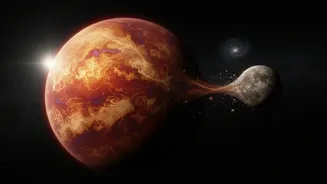
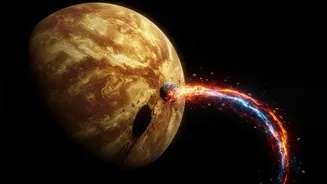
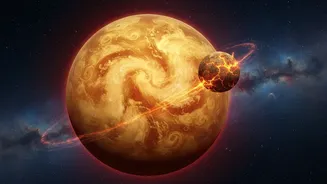
According to the models, this inward migration would end violently. As the moon spiraled closer, it would eventually cross the 'Roche limit,' the point at which the planet's tidal forces are strong enough to rip a celestial body apart. The ill-fated moon would have been shredded into a temporary ring of debris, which would then rain down onto Venus’s surface. The simulations also produced an unexpected finding: a more massive moon would have accelerated its own demise. A bigger moon exerts a stronger gravitational pull, which would slow Venus’s rotation down even faster, causing the tidal reversal to happen sooner and hastening the final crash. Depending on Venus's initial spin, a moon twice the mass of our own could have been destroyed in as little as 30 million years.
Could This Explain Modern Venus?
While the research doesn't prove Venus definitely had a moon, it shows that the planet’s current moonless state can be explained without an external catastrophe. The impact from a crashing moon would have been monumental, transferring an enormous amount of energy and momentum to the planet. Scientists speculate such an event could have profoundly altered Venus's geology and climate. Some research suggests early Venus may have been a much different world, potentially with oceans and habitable temperatures for billions of years. The cataclysmic end of a moon could have been a contributing factor that sent the planet down the path to becoming the scorching, high-pressure world it is today, though the exact climate consequences remain a topic for future research.