




Meet PRIMA: NASA's Next Cosmic Explorer
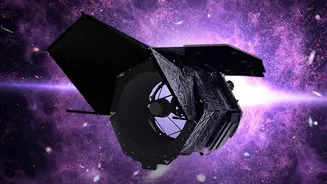
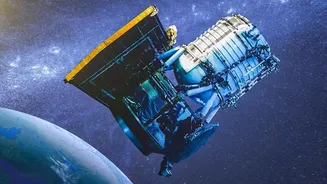
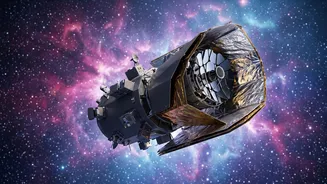
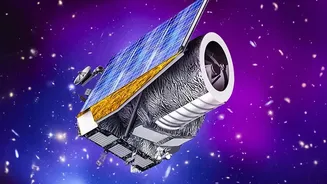
NASA has officially announced it is moving forward with the PRobe far-Infrared Mission for Astrophysics, or PRIMA. This new space telescope is engineered to observe the universe in far-infrared light, a part of the electromagnetic spectrum that is invisible
to the human eye and largely inaccessible to other major observatories like the James Webb Space Telescope (JWST). While JWST excels at near- and mid-infrared, PRIMA will bridge the gap between it and ground-based radio telescopes, giving astronomers a more complete picture of cosmic processes. The mission will be managed by NASA's Jet Propulsion Laboratory and, if it proceeds, is slated for a five-year mission beginning no earlier than 2033.
A New Window on a Dusty Universe
So, why far-infrared? This type of light is perfect for studying objects that are either too cold or too obscured by cosmic dust to be seen with other telescopes. Much of the universe is filled with vast clouds of gas and dust, which act like a celestial fog, blocking visible and ultraviolet light. Far-infrared radiation, however, can penetrate these clouds, allowing scientists to see what lies within. This capability will enable PRIMA to tackle some of the biggest questions in modern astronomy. Its main objectives include studying the formation of planets and the origins of water, tracking the evolution of galaxies and their supermassive black holes, and understanding how cosmic dust and heavy elements have accumulated throughout history.
The 'Practical Angle': A New Class of Mission
The headline's mention of a "more practical angle" refers to the mission's place within NASA's new strategic approach. PRIMA is the first mission in a new category called Probe Explorers, which was recommended by the National Academies' 2020 Decadal Survey. This class is designed to fill a strategic and financial gap between smaller, less expensive Explorer-class missions and the massive, multi-billion-dollar flagship observatories like JWST. With a project cost cap of $1.2 billion, Probe-class missions like PRIMA are intended to be powerful scientific tools that can be developed on a more predictable cadence and budget, without straining the agency's entire astrophysics portfolio. This makes high-priority science achievable in a more sustainable way.
What is the Confirmation Review?
Before PRIMA can get the final green light, it must pass a critical milestone known as a confirmation review. The mission has now entered what NASA calls Phase B, a period focused on advancing the preliminary design and developing key technologies. The confirmation review will assess the mission's technical plans, its programmatic schedule, and its cost performance. Essentially, NASA leadership and external experts will scrutinize the project to ensure it is feasible, well-planned, and on-budget before committing to the next major stage, Phase C, which involves final implementation and construction. This rigorous review process is standard for all major NASA projects and is designed to prevent costly overruns and delays down the line.
Building on the Legacy of Spitzer and Herschel
PRIMA is not the first telescope to venture into the far-infrared. It follows in the footsteps of previous pioneering missions like NASA's Spitzer Space Telescope and the European Space Agency's Herschel Space Observatory. However, PRIMA will represent a significant technological leap forward. It will feature a 1.8-meter (5.9-foot) primary mirror that is cryogenically cooled to just a few degrees above absolute zero. This extreme cold is vital because it suppresses the telescope's own heat emissions, which would otherwise blind its highly sensitive detectors to the faint far-infrared light from distant galaxies. This, combined with new detector technology, will make PRIMA vastly more sensitive than its predecessors, allowing it to create deep surveys of the cosmos with unprecedented clarity.