






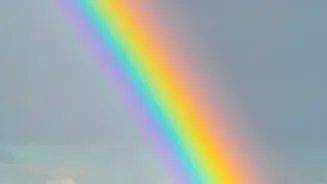
What Exactly Is a 'Fire Rainbow'?
Despite its dramatic name, a fire rainbow has nothing to do with fire. It's an optical phenomenon in the atmosphere, and its proper scientific name is a circumhorizontal arc. The term 'fire rainbow' likely comes from its vibrant, flame-like colours and its broad,
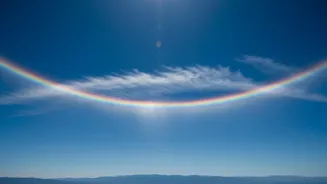
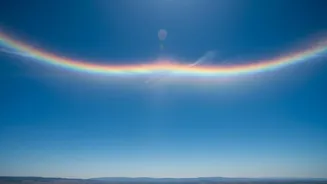
rainbow-like spectrum. Unlike a traditional rainbow, which forms a high arc opposite the sun, a circumhorizontal arc is a wide, flat band of colour that runs parallel to the horizon, far below the sun. This distinction is key; while they both involve light and the sky, the mechanics behind them are completely different.
The Science of Light and Ice
So, if it’s not a rainbow, how does it form? The magic happens high up in the atmosphere inside thin, wispy cirrus clouds. These clouds, floating at altitudes above 18,000 feet, are composed of millions of tiny, plate-shaped hexagonal ice crystals. For a fire rainbow to appear, two very specific conditions must be met. First, the sun must be very high in the sky—at an elevation of more than 58 degrees above the horizon. Second, the flat, hexagonal ice crystals within the cirrus clouds must be oriented horizontally, like a collection of tiny floating plates. When sunlight enters the vertical side of one of these crystals, it bends (or refracts) and exits through the horizontal bottom face. This 90-degree bending of light acts like a prism, splitting the sunlight into its component colours and creating the spectacular display we see from the ground.
NASA's Latest Showcase
NASA's Astronomy Picture of the Day recently featured a remarkable example of a circumhorizontal arc, bringing this rare phenomenon back into the spotlight. The image, taken over West Virginia, showcases the vibrant colours and distinct horizontal shape that make fire rainbows so unique. Such images are valuable because they provide a clear, striking illustration of complex atmospheric optics at play. For scientists, they are a visual confirmation of specific cloud conditions and crystal alignments. For the public, they are an inspiring reminder of the natural beauty that can appear in the sky when the conditions are just right.
Rainbow vs. Fire Rainbow
It’s easy to confuse any colourful arc in the sky with a rainbow, but the differences are significant. A classic rainbow is formed by sunlight refracting and reflecting inside liquid water droplets, usually after a rainstorm. It always appears in the part of the sky opposite the sun. A fire rainbow, or circumhorizontal arc, is formed by the refraction of light through ice crystals and always appears below the sun, parallel to the horizon. Another phenomenon, called cloud iridescence, can also create rainbow-like colours in clouds. However, iridescence is caused by diffraction (the bending of light waves around obstacles) in water droplets or ice crystals of varying sizes, often creating more random, patch-like colours that can appear much closer to the sun.
Tips for Spotting Your Own
Seeing a circumhorizontal arc is a matter of being in the right place at the right time. Because they require the sun to be very high, they are primarily a mid-latitude phenomenon seen during the summer months. Locations north of 55° latitude, for instance, rarely see them because the sun never gets high enough in the sky. To improve your chances, keep an eye out for high, thin cirrus clouds on bright, sunny days, especially around midday when the sun is at its highest point. Wearing polarizing sunglasses can also help make the colours of a faint arc more visible against the bright sky. It's a rare sight, but one that is well worth looking up for.