








A Leap in Mind-to-Text
Meta's latest AI project, called Brain2Qwerty v2, represents a significant breakthrough in decoding human thought. In a recent announcement, the company revealed the system can interpret brain signals from a person thinking about typing, and convert them
into sentences in real-time. The results are impressive: the AI achieved an average word accuracy rate of 61% across several participants. For the top-performing individual, that figure jumped to 78%. To put this in perspective, previous non-invasive methods struggled to get past 8% accuracy, making this a nearly eightfold improvement. Unlike earlier systems that could only decode individual characters, Brain2Qwerty v2 uses advanced deep learning and Large Language Models (LLMs) to reconstruct whole words and coherent sentences directly from raw brain signals. This leap was achieved by training the AI on a dataset of around 22,000 sentences, collected from volunteers who each spent about 10 hours typing while their brain activity was recorded.
The Science of Brain Reading
The magic behind this breakthrough isn't a simple headset; it's a highly sophisticated medical imaging technology called magnetoencephalography, or MEG. Every time you have a thought, your brain's neurons fire, creating minuscule electrical currents. These currents, in turn, produce equally tiny magnetic fields. A MEG machine uses an array of extremely sensitive sensors, known as SQUIDs, to detect these magnetic fields from outside the head.
Unlike other brain-scanning methods like fMRI, which measures blood flow and is much slower, MEG captures brain activity directly and on a millisecond-by-millisecond basis. This incredible speed is what allows Meta's AI to decode activity in real-time. The system is entirely non-invasive, meaning it requires no surgery or implants, a key distinction from other high-profile brain-computer interface projects. Participants simply wear a large, helmet-like device that houses the sensors.
The Million-Dollar Bottleneck
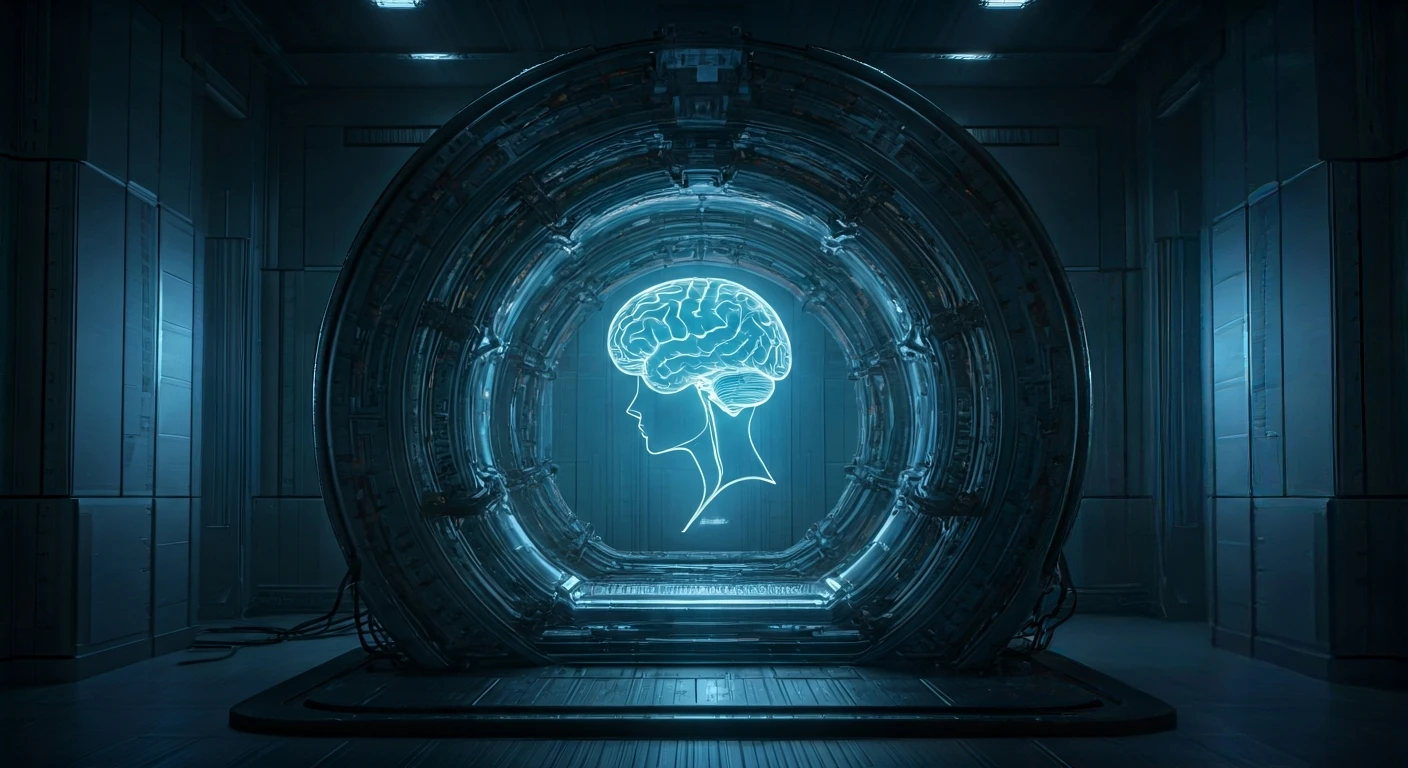
Herein lies the major hurdle mentioned in the headline. MEG scanners are anything but portable or consumer-friendly. These are massive, multi-million-dollar pieces of equipment typically found only in advanced research hospitals and universities. The SQUID sensors must be cooled to -269 degrees Celsius with liquid helium to work, adding another layer of complexity and cost. Furthermore, the brain's magnetic signals are so faint—a billionth of the Earth's magnetic field—that the entire system must be housed in a magnetically shielded room to block out interference from everything from passing cars to the planet itself.
This is the reality check on the dream of typing an email just by thinking about it. While the AI is becoming incredibly capable, the hardware it depends on is stationary, expensive, and requires a highly controlled environment. It's not a device you'll be seeing on store shelves anytime soon, and this dependency firmly anchors the technology in the laboratory for the foreseeable future.
Beyond the Lab: The Ultimate Goal
Despite these physical limitations, the purpose behind Meta's research is deeply human. The company has stated its long-term goal is to develop clinical tools to help people who have lost their ability to speak due to brain lesions, neurological diseases, or injury. For millions of people globally, a non-invasive way to restore communication would be transformative.
By making its research and even its training code open to the public, Meta hopes to accelerate progress across the entire field of neuroscience. The success of Brain2Qwerty v2 proves that with enough data and sophisticated AI, non-invasive brain decoding is a viable path forward. The accuracy even appears to improve the more data the system is trained on, suggesting there is still more potential to unlock. The challenge now is twofold: continuing to refine the AI's accuracy while also hoping that, in parallel, the hardware for sensing brainwaves becomes smaller, cheaper, and more accessible.