



The Moon’s Communication Blind Spots
For decades, communicating with missions on the Moon has relied on a direct line of sight to Earth. If you can't see Earth, you can't talk to it. This creates enormous black-out zones, rendering the entire far side of the Moon silent and unreachable.
Even at the coveted South Pole, a prime target for future missions due to potential water ice, Earth hangs low on the horizon. The rugged, cratered terrain constantly blocks the signal, making reliable communication a significant challenge. This limitation severely restricts where rovers can safely explore and where astronauts can establish a long-term habitat. Without a constant link, real-time support and high-volume data return are simply impossible.
Building the 'Lunar Internet'
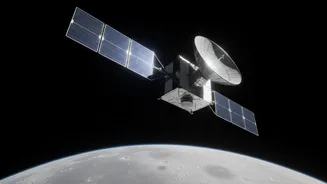
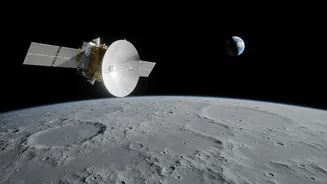
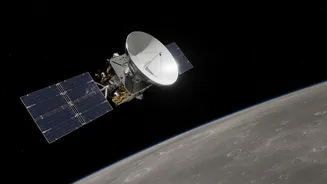
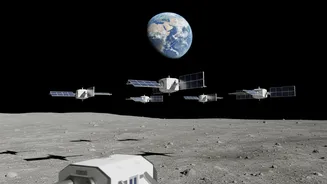
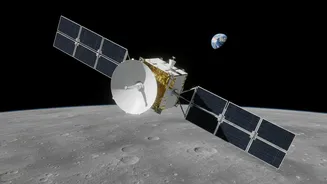
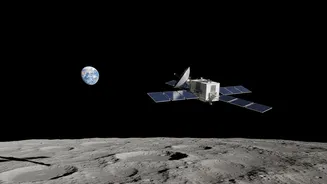
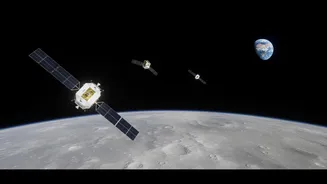
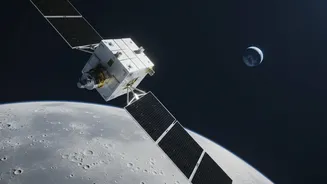
To solve this, NASA is establishing the Lunar Communications Relay and Navigation Systems (LCRNS). This initiative isn't about NASA launching its own satellites, but rather fostering a commercial partnership to create a network of private satellites orbiting the Moon. This system is a key part of a broader international framework called LunaNet, which aims to create a true 'internet' for the Moon, complete with standardized protocols that allow different missions from various nations and companies to connect seamlessly. Think of it as building the Moon's first Wi-Fi and GPS network, providing continuous coverage everywhere on the lunar surface and in orbit. The European and Japanese space agencies are developing compatible systems, ensuring it will be a truly global asset.
More Than Just a Phone Call Home
The LCRNS network will do far more than just relay simple commands. It's designed to provide two revolutionary services. First, it offers high-bandwidth networking capable of streaming high-definition video and transferring massive scientific datasets from lunar assets back to Earth. It uses advanced Delay/Disruption Tolerant Networking (DTN), a technology that stores data packets if a connection is temporarily lost and forwards them once the link is re-established, ensuring information is never lost. Second, the system will provide Position, Navigation, and Timing (PNT) services—essentially, a GPS for the Moon. This gives rovers and astronauts precise, real-time location data without needing constant contact with Earth, enabling a new level of autonomy and navigational safety.
Unleashing the Next Generation of Rovers
For future lunar rovers, this communications backbone is a game-changer. With a stable, high-speed link, scientists on Earth can engage in complex telerobotics, controlling rovers with unprecedented precision. It opens up vast, previously unexplored territories, like the permanently shadowed craters at the poles, which are impossible to investigate without a relay system. Rovers will be able to venture into these dark, scientifically rich areas, searching for water ice while streaming their findings back in real time. For crewed missions, the impact is just as profound. Astronauts driving the Lunar Terrain Vehicle will have reliable voice communications and a GPS-like map, dramatically improving the safety and efficiency of their extravehicular activities (EVAs).
The Foundation for a Sustainable Future
Ultimately, the lunar relay network is the invisible infrastructure that makes a permanent human presence on the Moon viable. It’s a foundational element of NASA's Artemis program, which aims not just to visit the Moon, but to stay. By building this system through commercial partners like Intuitive Machines, NASA is also kick-starting a new lunar economy. This network won't just serve NASA's needs; it will be available to international partners and private companies planning their own missions. It’s the digital highway that will support future science labs, resource extraction operations, and eventually, a thriving community beyond Earth, all starting with the crucial need for a reliable link home.