






Why Your Back Hates Your Chair
Our bodies are designed for movement, but modern work often involves sitting for hours on end. This prolonged sitting puts constant pressure on the spine, particularly the lower back. It causes muscles like your hip flexors to shorten and tighten, while
weakening your core and glutes, which are essential for spinal support. Over time, this combination of muscle imbalance and spinal compression can lead to poor posture, stiffness, and chronic pain. Slouching only makes it worse, putting extra strain on your spinal discs. The good news is that you can counteract these effects with small, mindful movements throughout your day.
1. Seated Cat-Cow for Spinal Flow
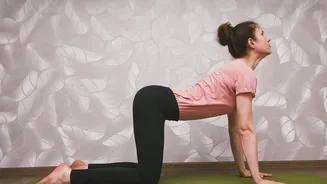
This fundamental yoga movement is excellent for gently warming up and increasing the flexibility of your spine. How to do it: Sit tall at the edge of your chair with both feet flat on the floor. Place your hands on your knees. As you inhale, gently arch your back, push your chest forward, and look slightly up toward the ceiling (Cow pose). As you exhale, round your spine, tuck your chin to your chest, and draw your navel inward (Cat pose). Continue flowing between these two positions for 5-10 breaths, moving with your breath to release tension.
2. Chair Pigeon Pose for Hip Relief
Tight hips are a major contributor to lower back pain. This stretch targets the deep gluteal muscles and the outer hip, providing significant relief. How to do it: While seated, cross your right ankle over your left thigh, just above the knee. Keep your right foot flexed to protect the knee joint. Sit up straight, and if you feel a good stretch, hold it here. For a deeper sensation, gently hinge forward from your hips, keeping your spine long. Hold for 30 seconds, breathing into the sensation, then slowly rise and switch to the other side.
3. Seated Spinal Twist for Tension Release
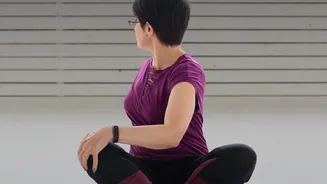
A gentle twist can help relieve tension in the back, improve spinal rotation, and even aid digestion. How to do it: Sit tall with your feet flat on the floor. Inhale to lengthen your spine. As you exhale, gently twist your torso to the right, placing your left hand on the outside of your right knee and your right hand on the back or side of the chair for support. Use the chair to deepen the twist gently, but don't force it. Keep both hips grounded in the chair. Hold for a few deep breaths, then return to center and repeat on the left side.
4. Desk Upward Dog for a Better Posture
This modification helps counteract the forward slouch that is so common at desks by opening up the chest and shoulders. How to do it: Stand facing your desk and place your palms on its edge, shoulder-width apart. Walk your feet back until your body forms a straight line from head to heels. Gently press your hips forward toward the desk, lift your chest, and pull your shoulders back and down. You should feel a stretch across your chest and the front of your body. Gaze forward, keeping your neck long. Hold for 15-30 seconds.
5. Shoulder Rolls and Neck Stretches
Tension often accumulates in the neck and shoulders during periods of concentration. Simple movements can offer immediate relief. How to do it: For shoulder rolls, inhale and lift your shoulders up toward your ears, then exhale and roll them back and down, squeezing your shoulder blades together. Repeat 5 times. For a neck stretch, sit tall and gently tilt your left ear toward your left shoulder. You can place your left hand on your head to add gentle pressure, but don't pull. Hold for 20-30 seconds, then switch sides.