







Peering Beneath the Crust
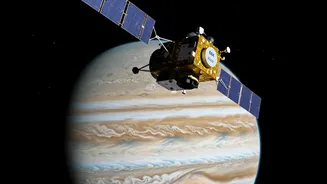
For the first time, scientists have measured the temperature beneath the chaotic surface of Io. Data from NASA's Juno spacecraft, collected during two daringly close flybys in late 2023 and early 2024, revealed something startling. Just a few feet below
the ground, the temperature rises by more than 22 degrees Celsius—a jump far too steep to be explained by sunlight alone. Using its Microwave Radiometer (MWR) instrument, originally designed to see through Jupiter's thick clouds, Juno was able to probe depths from a few inches down to tens of feet. This gave researchers an unprecedented look at Io's shallow subsurface, identifying localized warm patches that don't correspond to the obvious, glowing volcanoes we see on top.
The Engine of an Angry Moon
To understand Io’s heat, you have to understand its violent relationship with Jupiter. Io is caught in a gravitational tug-of-war with the gas giant and its other large moons, Europa and Ganymede. This constant push and pull, known as tidal heating, forces Io’s very surface to bulge up and down by as much as 100 meters. All that stretching and squeezing generates immense friction and heat deep within the moon's interior, making it the most volcanically active place in the solar system. For decades, scientists could only study the heat that reached the surface using infrared telescopes. Juno’s microwave observations are the first time we've been able to measure how that internal energy is working its way up through the crust.
Two Competing Theories
So what's causing these buried hot spots? Scientists have two main ideas. The first theory suggests the heat could be rising steadily from the moon's molten interior through a conductive crust. If this process is happening all over Io, it would mean the moon is releasing up to 30 times more heat than Earth does on average. The second possibility is that these warm patches are vast fields of lava that are still cooling down. On Io, new eruptions constantly bury older lava flows under layers of ash and other debris. These new deposits could be acting like an insulating blanket, trapping heat from the lava below and allowing it to stay warm for much longer than expected, hidden just a few meters beneath the surface.
A Surprisingly Smooth World
Beyond the hidden heat, Juno's flybys uncovered another surprise: large parts of Io are incredibly smooth. While the moon is known for its towering mountains, the microwave data revealed expansive plains stretching for over 100 kilometers. The surface material also appears to be of very low density, more like porous volcanic ash or pumice than solid rock. Researchers believe this is the result of Io’s relentless volcanism, which constantly repaves the landscape, burying older, rougher terrain under fresh, lightweight deposits. It paints a picture of a world that is not just active, but is in a constant state of renewal, smoothing over its own scars with each new eruption.
New Ways to Study Volcanoes
This discovery does more than just add another fascinating chapter to Io's story. It provides a brand-new technique for studying volcanism across the solar system. By showing that microwave instruments can detect subsurface heat, the Juno mission has opened the door to better understanding how heat and magma move beneath the surface of a planet or moon before an eruption. Scientists believe this method could one day be applied to volcanoes on Earth, potentially helping to improve our ability to monitor their activity. It could also help us study the ancient, dead volcanoes on Mars or even our own Moon, revealing geological secrets that have long been hidden from view.