

Hunga Tonga-Hunga Ha’apai (2022): The Water Vapor Bomb
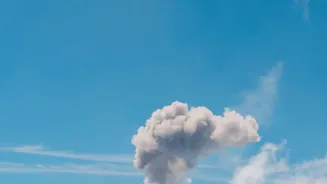
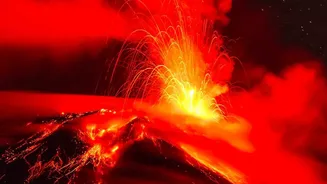
The eruption of the underwater Hunga Tonga-Hunga Ha’apai volcano in January 2022 was unlike anything seen in the modern satellite era. It was the largest volcanic explosion of the 21st century and the most powerful since Mount Pinatubo in 1991. Its sheer
force, equivalent to hundreds of atomic bombs, sent shockwaves circling the globe multiple times. But its most significant impact was not from ash or lava, but from water. Because it erupted from just under the ocean's surface, it blasted an unprecedented amount of water vapor—an estimated 150 million metric tons—directly into the stratosphere. This single event increased the total water content in the stratosphere by about 10%. While large eruptions typically release sulfur dioxide that forms sunlight-reflecting aerosols and causes temporary global cooling, the massive injection of water vapor, a greenhouse gas, had scientists concerned about a potential warming effect. However, subsequent analysis showed the eruption's effects were more complex, causing a minor and temporary cooling in the Southern Hemisphere. The event provided a unique natural experiment, revealing how water vapor can drastically alter stratospheric chemistry, even leading to temporary ozone loss.
Eyjafjallajökull (2010): The Great Disrupter
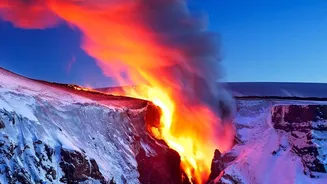
While not the most powerful in terms of explosive energy, the 2010 eruption of Iceland's Eyjafjallajökull volcano demonstrated modern society's profound vulnerability to volcanic events. The eruption occurred beneath a glacier, a combination that produced incredibly fine-grained ash particles. When this plume of abrasive silicate dust drifted over Europe, it posed a severe threat to jet engines. Fearing catastrophic engine failure, aviation authorities shut down a massive portion of European airspace for nearly a week. The shutdown was the largest air traffic disruption since World War II, causing the cancellation of over 100,000 flights and affecting millions of passengers. The economic impact was staggering, with airlines losing an estimated $1.7 billion in revenue. The event was a wake-up call, forcing the aviation industry and governments to reassess their protocols for flying in volcanic ash and highlighting how a single, moderately sized eruption could paralyze the globalized world.
Puyehue-Cordón Caulle (2011): The Globe-Circling Ash Cloud
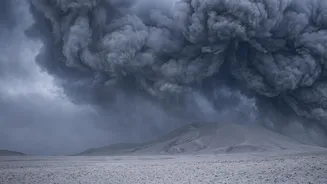
One year after Iceland's shutdown, a far more powerful eruption occurred in Chile. The Puyehue-Cordón Caulle volcanic complex exploded to life in June 2011, producing one of the largest eruptions of the century. It sent a colossal plume of ash and pumice high into the atmosphere, which was then carried eastward by strong winds. The ash cloud circled the entire Southern Hemisphere in about two weeks, disrupting air travel across South America, South Africa, Australia, and New Zealand. An estimated one hundred million tons of ash were ejected. Unlike the brief, concentrated disruption of Eyjafjallajökull, the Puyehue-Cordón Caulle eruption was a long, drawn-out affair. The ash created a lingering hazard, blanketing vast areas of Argentina in a thick layer that impacted agriculture and infrastructure. The eruption also left a unique geological signature: a massive lava flow made of nearly pure obsidian, a type of black volcanic glass.
Kasatochi (2008): Erasing and Resetting an Ecosystem
Sometimes the greatest change happens on a local scale. In August 2008, the small Kasatochi Island in Alaska’s Aleutian chain, a vital habitat for hundreds of thousands of seabirds, erupted violently. The eruption, from a volcano with no confirmed historical activity, was devastating. It buried the entire island under meters of ash and pyroclastic flow deposits, essentially sterilizing it. The formerly lush landscape was transformed into a grey, barren moonscape, with the island itself physically growing in size. However, this destruction also created an unprecedented scientific opportunity. Researchers have been studying Kasatochi ever since, watching as life slowly returns in a process called primary succession. The eruption wiped the slate clean, allowing scientists to monitor how a complex ecosystem rebuilds itself from virtually nothing, offering priceless insights into how life colonizes a brand-new surface.