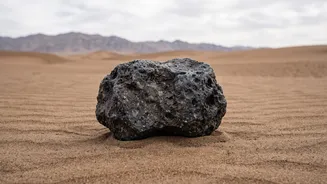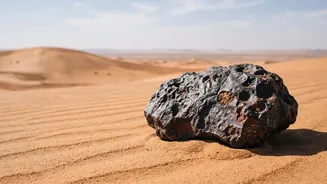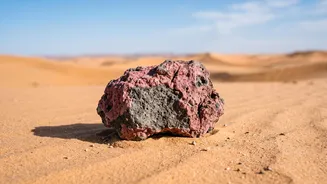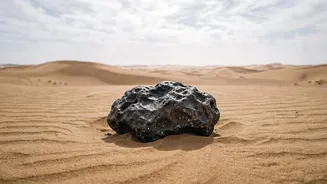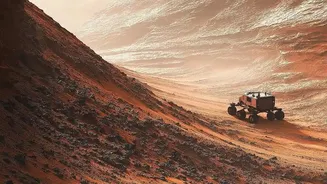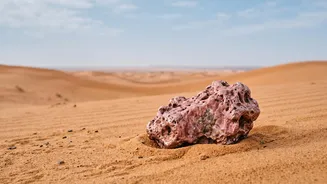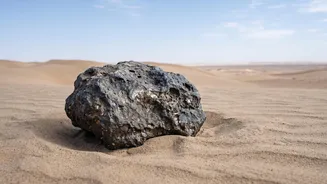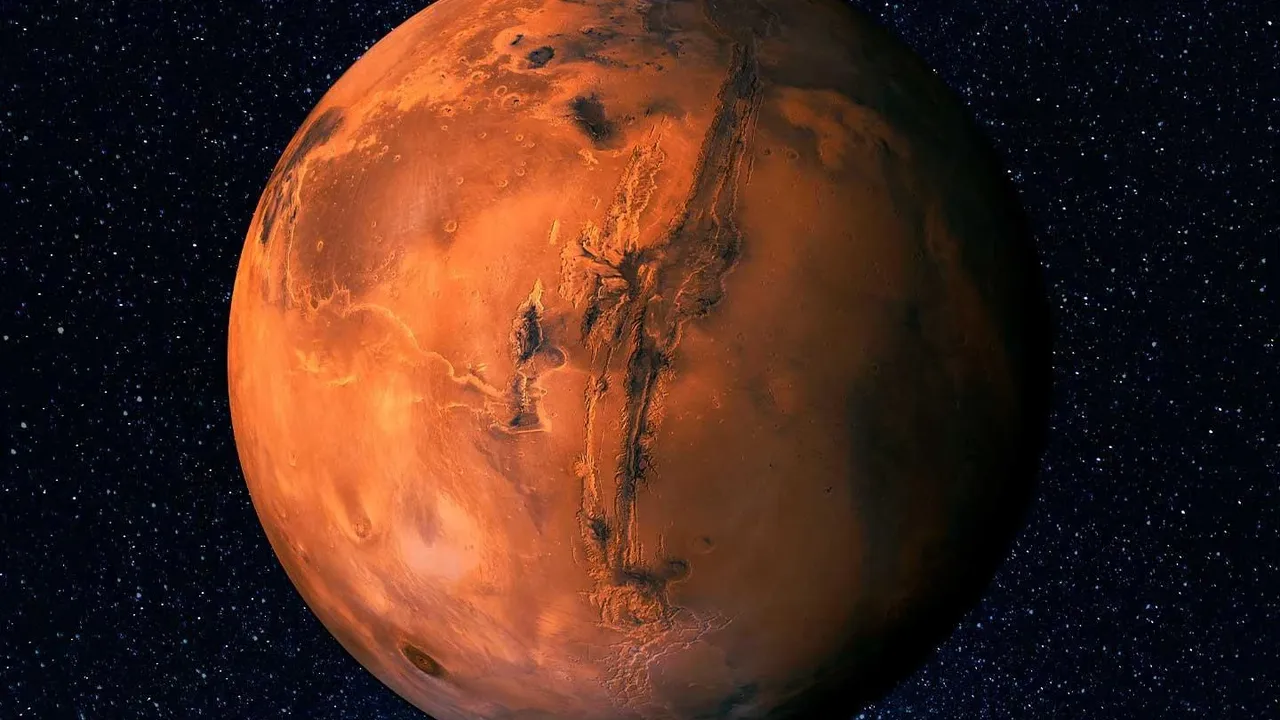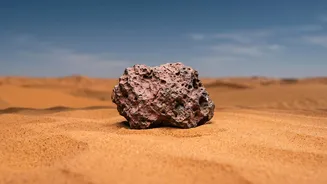

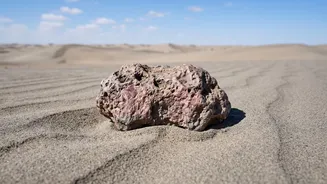

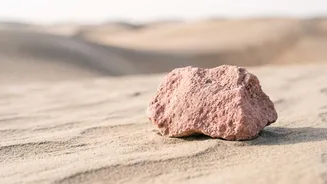
It sounds like something from a storybook: a beautiful, rose-coloured stone, cast off from another world, is discovered in a desert on Earth. But this is no fairy tale. This is the story of Teghaza 001, a real Martian messenger.
A Messenger from a Bygone Era
In 2022, meteorite hunters
scouring the Sahara Desert in Mali came across fragments of an unusual, reddish-hued rock. Named Teghaza 001 after the salt plain where it was found, the collection of eight pieces, weighing about 800 grams in total, didn't immediately reveal its extraordinary secret. It was only after careful analysis by NASA-funded scientists that its true identity was confirmed: this was no ordinary space rock, but a piece of Mars. And not just any piece, but one of the oldest ever found, dating back more than 4.1 billion years. This incredible age places its formation in the earliest chapter of Martian history, a time when Earth itself was in its infancy and life was just beginning to emerge.
A 'Rosetta Stone' for Mars
Scientists are calling Teghaza 001 a 'Rosetta Stone' for Mars, a key to unlocking the planet's ancient secrets. Unlike most of the 400-plus Martian meteorites found on Earth, which are typically much younger, this rock provides a rare glimpse into the planet's formative period. Its unique mix of igneous minerals tells a two-part story. First, it chronicles the creation of Mars's early crust, formed as molten magma from the planet's interior cooled and solidified. Second, it carries the chemical fingerprints of being altered by subsurface water, offering a physical record of the interaction between rock and water on the young planet. This makes it a priceless sample from a part of Mars's crust that scientists have never been able to study up close before.
Reading the Clues in the Crystals
The key to dating the meteorite and its history lay in tiny zircon crystals embedded within it. Zircons are like geological time capsules; by analysing the radioactive decay of elements like uranium to lead within them, scientists can precisely determine their age. This analysis confirmed the rock formed at least 4.1 billion years ago. But the crystals revealed more. They showed signs of being chemically altered by water around that same time, suggesting that liquid water was present and interacting with the Martian crust very early on. This supports the idea that early Mars had a more dynamic water cycle than previously thought, a crucial ingredient when considering the planet's potential for ancient habitability.
An Incredible Journey to Earth
The story of how Teghaza 001 reached us is almost as remarkable as what it contains. At some point in the distant past, a powerful asteroid or comet slammed into Mars, striking with enough force to blast pieces of the crust into space, overcoming the planet's gravity. This fragment then likely spent millions of years orbiting the sun before its path finally intersected with Earth's. It survived a fiery entry through our atmosphere before landing in the Sahara, where its unusual appearance made it stand out against the barren landscape, waiting to be discovered. While its exact origin crater is unknown, its mineral composition matches observations made by NASA's Mars Reconnaissance Orbiter of the planet's ancient southern highlands, a heavily cratered and geologically old region.