






The cosmos is filled with mysteries, from the echo of the Big Bang to the formation of planets. NASA’s SPHEREx mission is a new detective on the case, designed to map the entire sky in unprecedented detail, with a special focus on brown dwarfs.
Meet NASA’s New Cosmic Cartographer
SPHEREx,
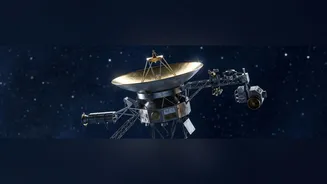
which stands for Spectro-Photometer for the History of the Universe, Epoch of Reionization, and Ices Explorer, is a space telescope with a grand ambition. Launched in March 2025, its two-year primary mission is to scan the entire sky every six months, creating a comprehensive map of the cosmos. Unlike previous all-sky surveys, SPHEREx observes the universe in 102 different colours of near-infrared light. This isn't about pretty pictures; it’s about spectroscopy. By splitting light into its component wavelengths, much like a prism, scientists can identify the chemical composition and determine the distance of hundreds of millions of objects, creating a 3D map of the universe. This powerful capability will help astronomers tackle some of the biggest questions in science, including the rapid expansion of the early universe and the origins of galaxies.
The Enigma of Brown Dwarfs
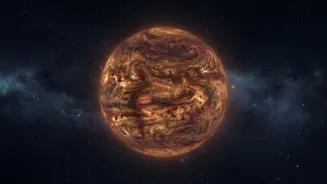
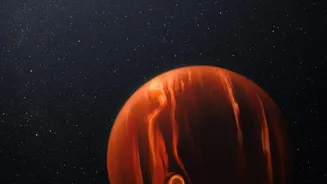
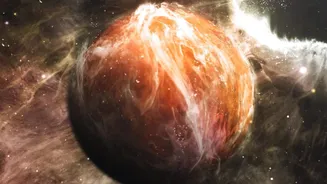
Among the billions of objects SPHEREx will study, one class stands out: brown dwarfs. These celestial bodies are fascinatingly ambiguous, often called 'failed stars' because they don't quite fit the mould of a star or a planet. Like stars, they form from the gravitational collapse of gas clouds. However, they never accumulate enough mass—typically falling between 13 and 80 times the mass of Jupiter—to ignite and sustain the hydrogen fusion that makes stars shine. While some can briefly fuse a heavier element called deuterium, they eventually cool and fade over millions of years, emitting only a dim glow in the infrared spectrum. This makes them incredibly difficult to find and study, leaving them as one of the great missing links in our understanding of celestial formation.
How SPHEREx Hunts for Failed Stars
This is where SPHEREx's unique abilities come into play. Because brown dwarfs are cool and dim, they are best observed in infrared light—exactly the part of the spectrum SPHEREx is designed to see. More importantly, the telescope's sensitive spectrometer can detect the chemical fingerprints of molecules in their atmospheres. As brown dwarfs cool, their atmospheres form complex clouds and are rich in molecules like water, methane, and carbon monoxide. These molecules absorb light at very specific infrared wavelengths. By mapping the sky in 102 colours, SPHEREx can spot the tell-tale spectral signatures that scream 'brown dwarf,' even from vast distances. Because it can observe wavelengths that are blocked by Earth's atmosphere, it is uniquely equipped for this cosmic census, with scientists expecting to analyse thousands of these objects.
Bridging the Gap Between Stars and Planets
Finding thousands of brown dwarfs isn't just about cataloguing oddities; it's about understanding our own origins. Brown dwarfs occupy a crucial gap between the largest gas giants, like Jupiter, and the smallest stars. Studying their populations, distribution, and atmospheric composition provides a vital testing ground for theories of both star and planet formation. For example, do they form in isolation like stars, or are they sometimes formed in the dusty disks around larger stars, like planets? Because they often drift alone in space, their atmospheres are easier to study than those of exoplanets, which are often blinded by the glare of their parent stars. In this way, brown dwarfs serve as a natural laboratory for understanding the physics and chemistry of planetary-scale atmospheres.