







A Famous Star Gets a New Planet
Just 63 light-years from Earth lies a star that has fascinated astronomers for decades: Beta Pictoris. It is remarkably young, at only about 20 million years old, compared to our middle-aged Sun, which is 4.6 billion years old. This youth makes it a perfect
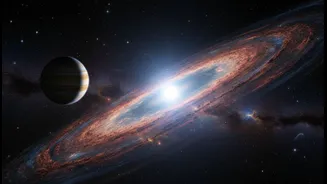
laboratory for watching a planetary system in its infancy. The star is surrounded by a massive, bright disk of dust and gas—the raw materials for planet-making. For years, scientists knew of two giant planets, Beta Pictoris b and c, orbiting the star. Now, two independent teams of astronomers have confirmed a third: Beta Pictoris d.
An Orbit of Epic Proportions
The headline fact about Beta Pictoris d is its enormous orbit. The planet circles its star at a distance of about 26 to 30 astronomical units (AU). One AU is the distance from the Earth to the Sun. So, this new planet orbits its star at a distance roughly 30 times greater than our own. To put that in perspective, it is comparable to Neptune's orbit in our own solar system. This makes it the outermost of the three known planets in the Beta Pictoris system, with a journey around its star taking about 91 years to complete.
A Game of Planetary Hide-and-Seek
Discovering Beta Pictoris d was a major achievement. It is about 2.4 times the mass of Jupiter, making it the least massive of the three planets in its system. Its vast distance from the star and relatively small size make it incredibly faint. In fact, it is about 100 times fainter than its sibling planet, Beta Pictoris b, and is among the faintest exoplanets ever to be directly imaged from the ground. The planet was discovered serendipitously. One team found it using the James Webb Space Telescope while another group, using the Very Large Telescope, spotted it by accident while studying Beta Pictoris b. It turns out the planet had been hiding in archival data for over a decade.
A New Way to Find Hidden Worlds
One of the most exciting aspects of the discovery was how it was made. While one team used direct imaging, another group using the James Webb Space Telescope found the planet not as a simple point of light, but by detecting the unique chemical fingerprint of its atmosphere. The telescope's NIRSpec instrument can map the chemical contents of a region, allowing it to isolate the molecular signatures of a planet's atmosphere even when the planet itself is lost in the glare of its star's dusty disk. This powerful technique could transform the search for other hidden exoplanets in similar complex systems.
Why This Distant Planet Matters
Beta Pictoris d isn't just another data point. Its existence helps solve a long-standing puzzle. Astronomers had noticed that the inner edge of the star's vast debris disk was sharply defined, and they had predicted a planet might be responsible for carving that edge. The discovery of Beta Pictoris d, orbiting just inside this disk, appears to confirm those predictions. The system, with its three giant planets at different distances, provides a unique snapshot of planetary evolution. It allows scientists to test theories about how giant planets form and migrate, offering clues about the diverse ways solar systems can be built across the galaxy.