





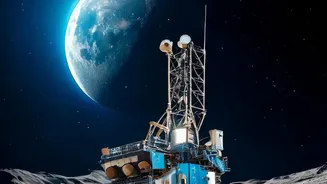
The Moon’s Communication Blind Spots
For as long as humanity has ventured into space, communication has been a direct-to-Earth affair. Radio signals connect Mission Control to spacecraft in a straight line. But this has a major limitation: if you don't have a direct line of sight to Earth,
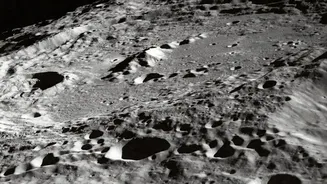
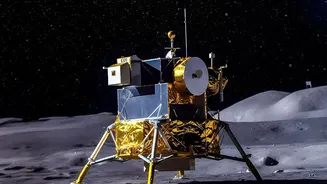
you're in the dark. On the Moon, this creates enormous communication blackouts. Astronauts or rovers on the lunar far side are completely cut off, and even missions near the coveted South Pole face periods of silence as the Moon's rugged terrain and rotation block the signal. These blackouts are not just inconvenient; they are a significant barrier to complex science, rover operations, and, most critically, astronaut safety. A sustainable human presence requires constant, reliable connectivity, something direct-to-Earth links can never fully provide.
An Internet for the Moon: LunaNet
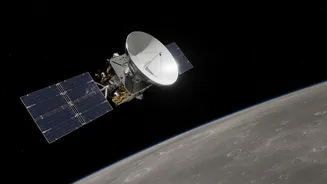
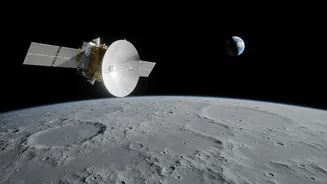
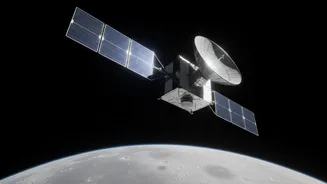
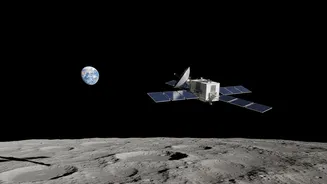
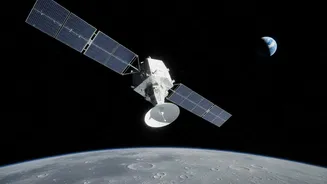
NASA's answer to this challenge is a visionary project called LunaNet. Think of it as creating an internet for the Moon, complete with its own satellite constellation. The plan involves placing a series of relay satellites in lunar orbit. These satellites will function like celestial cell towers, picking up signals from lunar missions—whether in orbit, on the surface, or even on the far side—and relaying them back to Earth. The project, formally known as the Lunar Communications Relay and Navigation Systems (LCRNS), aims to provide a flexible and scalable infrastructure. It’s not just about one or two satellites; it’s about building a persistent network that can grow as more missions arrive. Recent milestones, like the delivery of a key navigation payload to commercial partner Intuitive Machines for its first relay satellite, show the project is moving from concept to reality, with initial launches targeted for the coming years.
More Than Just a Phone Call Home
The capabilities of LunaNet extend far beyond simple voice chat. The architecture is designed to provide three core services: networking, precise navigation, and science utilization. This means high-speed data transfer for science experiments, real-time video, and the ability for rovers to be controlled with greater precision. Most importantly, it will offer Position, Navigation, and Timing (PNT) services, essentially a lunar GPS. Instead of relying entirely on tracking from Earth, future lunar explorers and autonomous systems will be able to determine their exact location, velocity, and time. This is a game-changer for landing accuracy, surface traversal, and coordinating multiple assets, from landers and rovers to orbiting spacecraft, all working together in a bustling lunar environment.
The Foundation for a Lunar Economy
This communication and navigation network isn't just for NASA. It's designed to be an open, interoperable system, much like the internet on Earth. NASA is actively partnering with commercial companies like Intuitive Machines and international space agencies to build out and use this infrastructure. The idea is to create a standardized framework that anyone—from the European Space Agency to private mining companies—can connect to. By providing this foundational layer, NASA is doing more than just supporting its own Artemis missions; it is laying the essential groundwork for a future lunar economy. Just as roads and the internet enabled unforeseen commercial activity on Earth, LunaNet is the public infrastructure that will enable science outposts, resource utilization, and other commercial ventures to operate effectively on and around the Moon.
A Blueprint for Mars and Beyond
LunaNet’s ambition doesn't stop at the Moon. The entire architecture is designed as a proving ground for an even greater goal: a solar system-wide internet. The challenges of communication delays and disruptions are magnified exponentially when dealing with missions to Mars, where one-way signal latency can be over 20 minutes. The principles being developed for LunaNet, such as Delay-Tolerant Networking (DTN) which allows data to be stored and forwarded through nodes, are directly applicable to a future MarsNet. By solving these problems at the Moon first, NASA and its partners are creating a replicable blueprint for the communications networks that will be necessary to support human exploration across the solar system, making our multi-planetary future a more connected and achievable reality.