




A Mysterious Glow in the Galaxy
In the vast expanse of the Milky Way, a team of researchers from China and the US has identified a mysterious source of high-energy gamma-rays. This faint glow, catalogued as HESS J1507−622, has puzzled scientists since it was first detected by telescopes
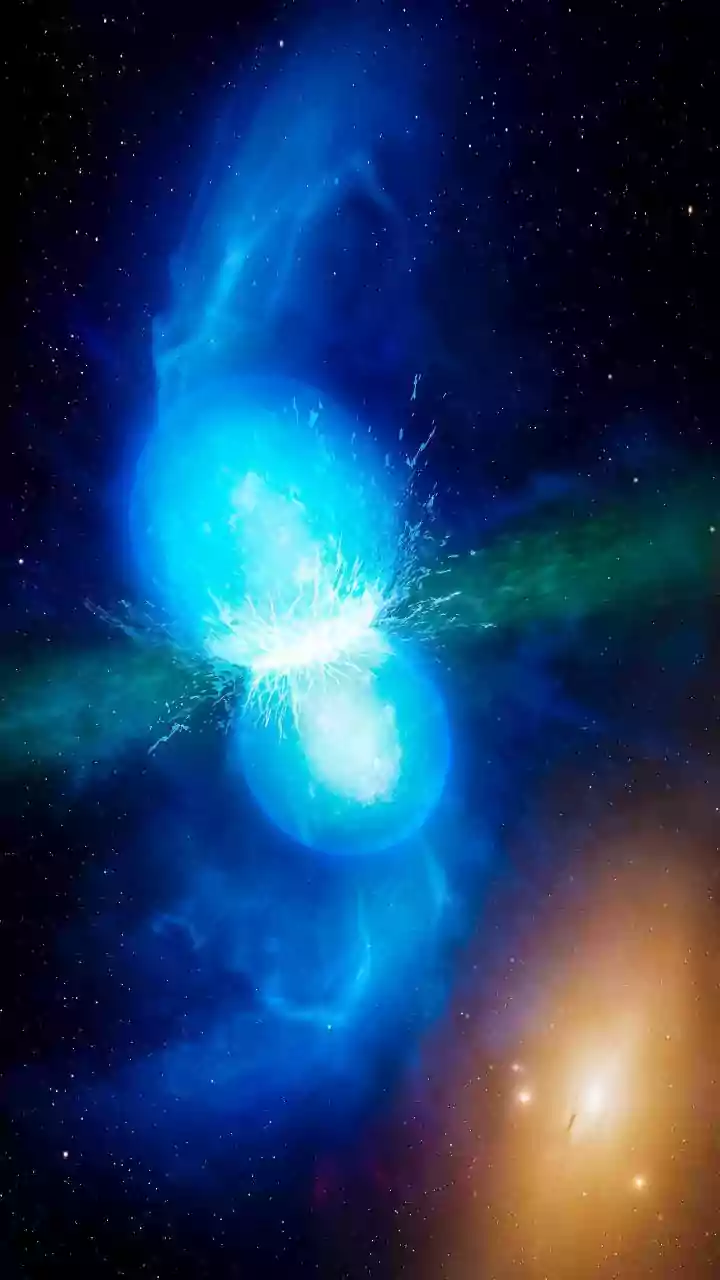
in Namibia over a decade ago. What makes it so unusual is that it emits powerful gamma-rays without any corresponding light in other wavelengths, like radio or X-rays. In a new study, which is yet to be peer-reviewed, researchers propose a compelling hypothesis: this glow is the fresh aftermath of a kilonova, a cataclysmic explosion resulting from the merger of two super-dense neutron stars. Its small size and brightness suggest the event happened less than 1,000 years ago in cosmic terms—a mere blink of an eye.
The Prime Suspect: A Kilonova
A kilonova is one of the most violent events in the universe. It occurs when two neutron stars, the collapsed cores of massive stars that have already exploded, spiral into each other and collide. These objects are so dense that a single teaspoon of their matter would weigh a billion tonnes on Earth. Their collision unleashes a tremendous blast of energy and matter, creating a transient spectacle that can outshine entire galaxies for a short period. Researchers believe such an event would have been visible from Earth, perhaps as bright as Jupiter in the night sky, though its southerly position might have hidden it from ancient astronomers in the Northern Hemisphere. If the HESS J1507−622 source is confirmed to be a kilonova remnant, it would be the first one ever identified within our own Milky Way galaxy.
The Missing Cosmic Treasure
These cosmic collisions are often called 'gold factories' for good reason. The extreme conditions during a kilonova are believed to be the primary source for many of the universe's heaviest elements through a process called rapid neutron capture, or the 'r-process'. As neutron-rich material is violently ejected, atomic nuclei rapidly soak up free neutrons, undergoing transformations to create elements like platinum, uranium, and gold. The first confirmed kilonova observation in 2017, known as GW170817, provided strong evidence for this theory by detecting the spectral signatures of these heavy elements in its aftermath. This makes the current finding so puzzling. While the gamma-ray data fits the model of a young kilonova remnant, the expected signature of gold and other heavy elements has not been detected, leaving a fascinating mystery for astrophysicists to solve.
Forging the Elements
Most elements are born from fusion inside stars, but this process generally stops at iron. To create heavier elements, a different, more violent mechanism is needed. The r-process provides the necessary conditions: an incredibly dense environment flooded with neutrons. During a neutron star merger, the ejected debris is a perfect breeding ground for this process. The radioactive decay of these newly minted, unstable elements is what powers the kilonova's glow over days and weeks. The exact elements produced, and the colour of the light they emit, depend on the specific conditions of the merger. Some kilonovae may produce a 'blue' light from lighter elements, while others glow 'red' from heavier, lanthanide-rich material. The absence of a clear heavy-element signal in HESS J1507−622 could challenge or refine these models, suggesting that not all kilonovae behave in the same way.
The Hunt for Confirmation
The research, posted on the preprint server arXiv, represents a compelling but preliminary step. The scientific community will now work to verify the findings through peer review and, crucially, further observation. The team’s model shows that the kilonova scenario is a consistent fit for the gamma-ray properties of HESS J1507−622, making it a powerful hypothesis. However, final confirmation requires more data. Future observations, potentially with advanced instruments like the James Webb Space Telescope, could search for the faint, lingering infrared glow expected from the radioactive decay of heavy elements. Confirming a young kilonova remnant in our galactic backyard would be a monumental discovery, offering an unparalleled opportunity to study the origin of the heaviest elements and the physics of the most extreme events in the cosmos.