


The Life Cycle of a Star
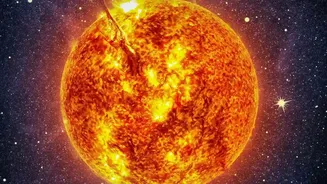
Like all living things, stars have a life cycle. For stars like our Sun, the end comes not with a bang, but with a dramatic expansion. After billions of years of fusing hydrogen into helium, the fuel in a star's core begins to run out. To compensate,
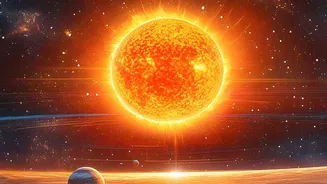
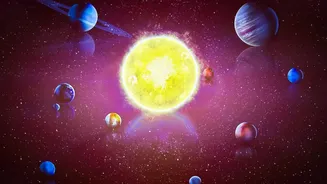
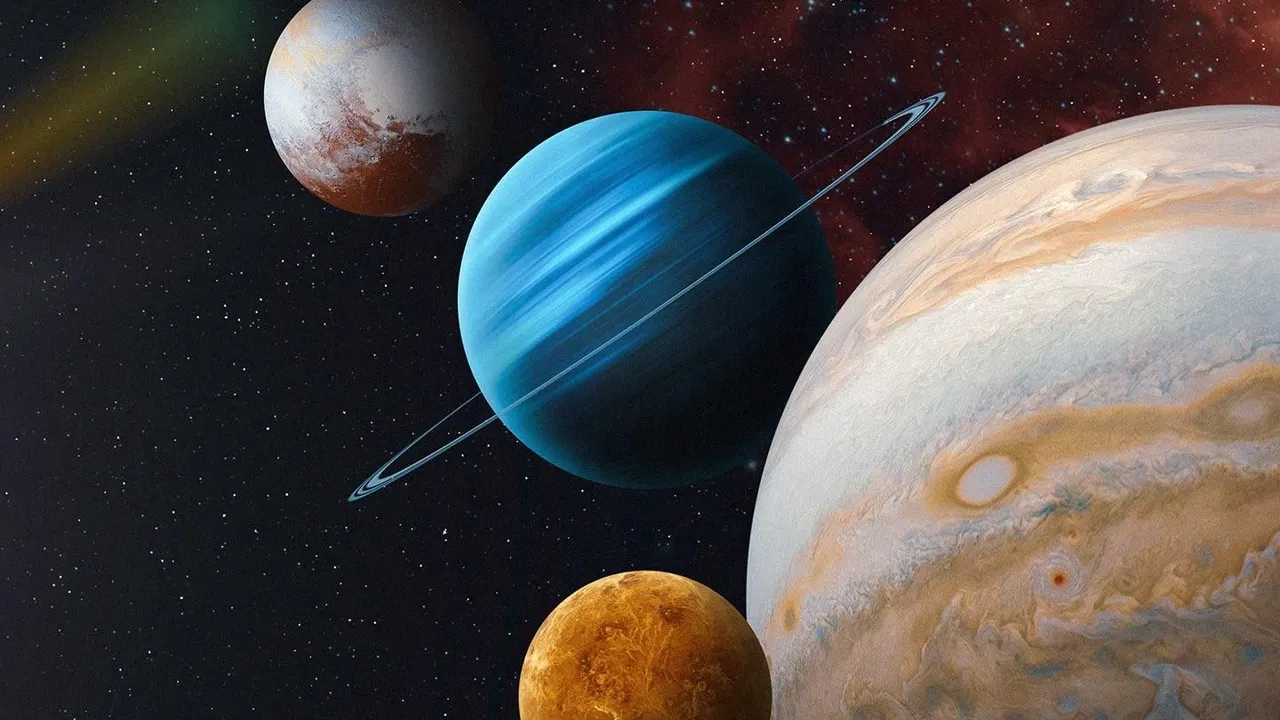
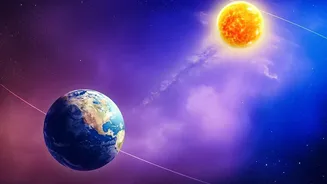
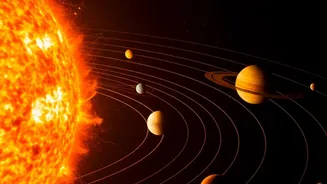
the star's outer layers swell enormously, cooling and reddening as they expand. It becomes a red giant. This transformation is immense; our own Sun is predicted to grow up to 100 times its current diameter in about five billion years. When this happens, anything too close is in peril. The star’s expanding atmosphere will engulf its innermost planets. For our solar system, this means the certain doom of Mercury and Venus, and very likely Earth as well. This process of planetary engulfment has been a cornerstone of stellar evolution models for decades, a predictable, if terrifying, forecast of our planet’s ultimate demise.
Hunting for Chemical Fossils
Before we could ever hope to see an engulfment happen, astronomers hunted for its aftermath. The primary method was to look for chemical anomalies in stars. One popular technique involves studying binary stars—two stars born from the same cloud of gas and dust, which should give them identical chemical compositions. If one star shows a higher concentration of heavy elements like iron, it's a strong clue that it may have consumed a rocky planet, altering its makeup. Another key piece of evidence is the presence of lithium. Sun-like stars burn through their lithium relatively quickly, so finding it in an older star is unusual. Since planets are rich in lithium, its unexpected presence in a star's atmosphere can act like a chemical fingerprint, suggesting the star recently snacked on one of its worlds. This evidence, however, is circumstantial—a fossil record of a crime long past, not a live recording of the event itself.
A Breakthrough Observation
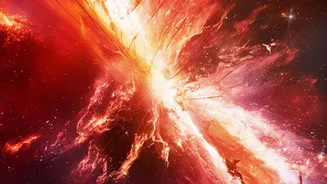
The game changed in 2020. Astronomers using the Zwicky Transient Facility (ZTF) in California noticed a star, located about 12,000 light-years away, that suddenly brightened by more than 100 times over just 10 days before fading. Initially, researchers were puzzled. It didn't look like other known stellar outbursts. The real breakthrough came when they combined this data with observations from NASA’s NEOWISE infrared space telescope. They discovered that the dramatic flash of visible light had been preceded by a more subtle, longer-lasting glow in the infrared spectrum—a sign of cool dust. This combination of a hot, fast outburst followed by a cold, dusty signal was the key. The team, led by MIT astronomer Kishalay De, concluded they had witnessed, for the first time, a star in the process of swallowing a planet, likely a gas giant the size of Jupiter.
Why 'Detection' Is Still an Interpretation
The discovery of ZTF SLRN-2020 was hailed as the first direct observation of a planetary engulfment, but it’s crucial to understand what "direct observation" means in astronomy. It wasn't a visual confirmation like watching a meteor burn up in Earth's atmosphere. Rather, it was a meticulous process of piecing together a puzzle from different light signals detected by multiple observatories. The energy of the outburst was about 1,000 times less than what would be expected from two stars merging, which helped rule out that alternative explanation. The leading theory is that as the Jupiter-sized planet was pulled into the star's atmosphere, it dragged gas from the star’s surface, which was ejected into space, cooled, and formed the dust cloud detected by the infrared telescope. The final plunge triggered the massive flare of light. This entire sequence is a narrative constructed by interpreting data through the lens of a sophisticated physical model. The model works beautifully and fits the data, but it highlights that even our most direct evidence is an act of expert interpretation, not simple sight.