



The Building Blocks of Everything
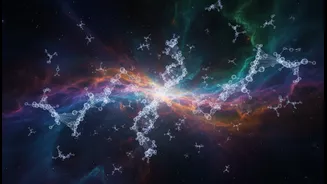
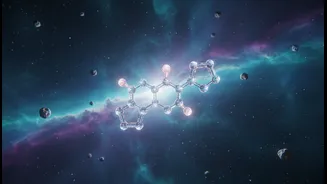
Before we can get to aliens and asteroids, we need to talk about amino acids. Simply put, they are the essential building blocks of life as we know it. These organic compounds link together to form proteins, and proteins do almost everything in our bodies.
They are responsible for the structure and function of our cells, tissues, and organs. Think of them as the microscopic workers that build everything from our muscles to the enzymes that help us digest our food. There are many types of amino acids, but all life on Earth uses a specific set of just 20 to construct its proteins. The origin of these specific molecules is one of the deepest mysteries in science, directly tied to the question of how life itself began.
A Special Delivery from Space
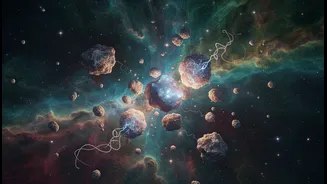
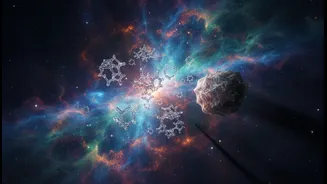
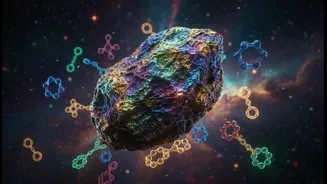
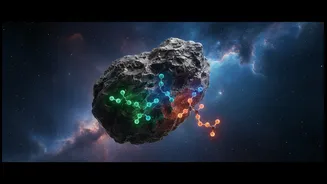
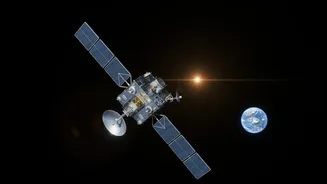
Scientists have long suspected that some of these life-starting ingredients could have come from space. Recent discoveries have turned that suspicion into a leading theory. Pristine samples collected from asteroids like Ryugu by Japan's Hayabusa2 mission and Bennu by NASA's OSIRIS-REx have provided stunning evidence. Analysis of these samples, collected directly from the asteroids and returned to Earth uncontaminated, revealed the presence of more than 20 different types of amino acids. Crucially, these rocks contain not just the kinds of amino acids common on Earth, but a diverse suite of organic molecules, proving they formed in the harsh environment of space. This wasn't just a lucky find; it was confirmation that these vital compounds are synthesized naturally throughout our solar system.
Meteorites: The Cosmic Postal Service
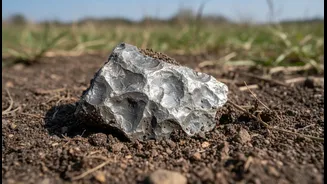
If amino acids are the message, then meteorites are the postal service. These fragments of asteroids and comets that survive their fiery journey through our atmosphere are essentially time capsules. Many are what's known as carbonaceous chondrites, rocks rich in carbon and water that date back to the formation of the solar system, about 4.6 billion years ago. They provide a snapshot of the chemical environment of the early solar system. The discovery of amino acids deep within these meteorites proves that these molecules could be safely shielded from the destructive radiation of space and the heat of atmospheric entry. They are robust travellers, capable of delivering their precious organic cargo intact to the surface of a young planet, like Earth.
Seeding a Lifeless Planet
This all leads to a fascinating and increasingly plausible idea called 'pseudo-panspermia'. This isn't the theory that alien microbes arrived on a spaceship, but the more subtle hypothesis that the raw ingredients for life were delivered from extraterrestrial sources. Billions of years ago, when Earth was a young, sterile planet, it was bombarded by a constant shower of comets and asteroids. This 'Late Heavy Bombardment' may have been a cosmic delivery system, seeding Earth’s oceans—the so-called primordial soup—with the amino acids and other organic compounds necessary for life to emerge. The discoveries on Ryugu and Bennu don't prove this is how life started, but they confirm that the key ingredients were available and the delivery mechanism was in place. They show that the chemical foundations for life may be common throughout the universe.
From Cosmic Dust to Us
The journey from a simple, space-borne amino acid to a complex, living organism is still a vast and largely unknown road. But having a ready supply of these building blocks is a critical first step. Scientists now believe that the chemistry that happened on the parent bodies of these meteorites—asteroids where water and minerals interacted—created a rich environment for organic molecule formation. A recent meteorite that landed in New Jersey in 2024 showed evidence of this complex chemistry, with salty brines on its parent asteroid potentially shaping the suite of organic molecules it carried. This suggests asteroids aren't just inert rocks, but dynamic chemical laboratories. The ingredients they forged and then delivered to Earth could have kickstarted the chemical reactions that eventually led to the first self-replicating molecules, and ultimately, to every living thing on our planet.