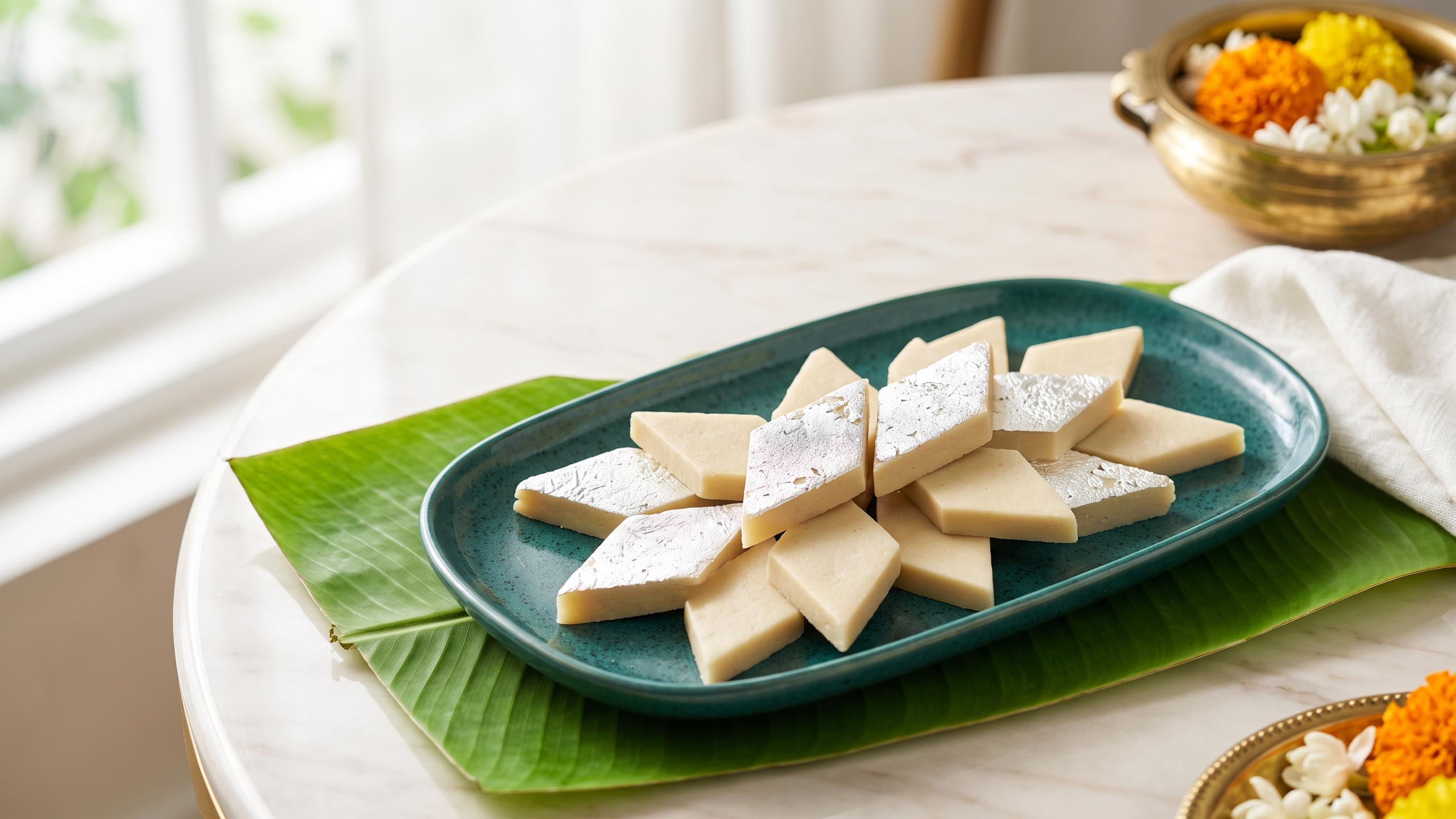

The Core Ingredients
The beauty of Kaju Katli lies in its simplicity. At its heart, this beloved sweet requires only three basic ingredients: cashews, sugar, and water. Many recipes also include a small amount of ghee for smoothness and flavour, and perhaps a few drops of rose
water or a pinch of cardamom powder for fragrance, though these are optional. For the best results, use good quality, raw cashews that are at room temperature. This minimal list ensures that the pure, nutty flavour of the cashews remains the star of the show. Some home cooks also add a little milk powder to achieve a creamier, softer texture similar to what you might find in a mithai shop, but it's not essential for a delicious outcome.
Step 1: The Perfect Cashew Powder
The texture of your Kaju Katli is determined right at the start. The goal is a fine, flour-like powder, not a paste. A common mistake is over-grinding the cashews, which causes them to release their natural oils and become clumpy or oily. To avoid this, use the 'pulse' function on your mixer or food processor, grinding in short bursts. If your cashews were stored in the refrigerator, let them come to room temperature first to ensure they are completely dry. Once you have a powder, it's a good idea to sift it to remove any larger pieces, which you can then grind again. This step is crucial for that signature smooth, melt-in-the-mouth feel.
Step 2: Mastering the Sugar Syrup
The sugar syrup is another critical stage. The traditional method requires cooking the sugar and water until it reaches a 'one-string consistency'. To test this, you can carefully take a drop of the cooled syrup between your thumb and forefinger; it should form a single, thin thread when you pull them apart. If the syrup is undercooked, the final mixture may be sticky. If it's overcooked, the Kaju Katli can become hard and crumbly. However, many modern, beginner-friendly recipes simplify this by instructing you to just dissolve the sugar in water and bring it to a rolling boil before adding the cashew powder. This no-fail method is less dependent on getting the consistency perfect.
Step 3: Cooking the Cashew Dough
Once your sugar syrup is ready, reduce the heat to low and add the sifted cashew powder. Stir continuously and vigorously to prevent lumps and ensure the mixture doesn't stick to the bottom of the pan. The mixture will begin to thicken. Continue cooking on low heat, stirring constantly, for about 5 to 9 minutes. You'll know it's ready when the mixture comes together, forming a single, soft mass or dough that starts to pull away from the sides of the pan. Be careful not to overcook it, as this can dry out the fudge and make it hard.
Step 4: Kneading and Rolling
Transfer the hot cashew dough onto a greased surface or, even better, a sheet of parchment paper. Let it cool for a few minutes until it's warm enough to handle but not completely cold. Grease your hands with a little ghee and knead the dough for about 30 seconds to a minute until it's smooth. This light kneading is key to a smooth final texture. Place another sheet of parchment paper on top and use a rolling pin to roll the dough out to your desired thickness, typically about 1/4 inch. Rolling while the dough is still warm is essential; if it cools too much, it will become hard and difficult to roll.