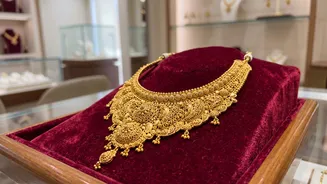









Many who bought gold during the recent Dhanteras festivities may have noticed a gap between the advertised price per gram and the final bill. This isn't an error, but a result of several components that build up the total cost you pay.
The 'Price Correction' of 2026
The term 'price
correction' was a major talking point this festive season. After hitting a record high of around ₹1.83 lakh per 10 grams in January 2026, domestic gold prices saw a significant fall. By the time Dhanteras arrived, prices had dropped by over 30% from that peak. However, despite this correction, prices were still about 7-10% higher than they were during Dhanteras 2025. This volatility, driven by international market trends, a stronger US dollar, and shifting investor sentiment, created a complex environment for buyers who were trying to time their purchases for the auspicious occasion. While sales volumes were expected to be flat, jewellers anticipated a rise in sales value due to the higher year-on-year prices.
Deconstructing Your Gold Bill: The Base Rate
The price you see flashing on a jeweller's board is the starting point. This is the base rate for gold, usually for 24-karat (99.9% pure) or 22-karat (91.6% pure) gold. This rate is determined by a combination of factors, including the international price set by benchmarks like the London Bullion Market Association (LBMA), the USD-INR exchange rate, and import duties. In India, the India Bullion and Jewellers Association (IBJA) publishes a daily benchmark rate that most retailers use as a reference. However, the final price of the jewellery you buy is always higher than this base rate because of other charges that are added on top.
The Key Factor: Understanding Making Charges
The most significant addition to your bill is 'making charges'. This is the cost of labour and craftsmanship required to convert raw gold into a finished piece of jewellery. These charges are not standardised and can vary dramatically, ranging anywhere from 5% to over 25% of the gold's value. The complexity of the design is a major determinant; intricate, handcrafted pieces command much higher making charges than simple, machine-made items like basic chains or coins. This is why two bangles of the same weight can have vastly different final prices. It’s a fee for the artistry, not just the metal.
How Making Charges are Calculated
Jewellers typically calculate making charges in two ways: as a percentage of the gold's value or as a flat rate per gram of gold. For instance, a jeweller might charge 15% on the value of the gold used, or a flat fee of ₹500 per gram. When calculated as a percentage, the making charge automatically increases if the base price of gold goes up, even for the same design. A flat rate per gram can be more transparent and easier to calculate. As a buyer, it is crucial to ask your jeweller how this charge is calculated, as it often represents a significant portion of the final cost and is a key area for potential negotiation.
The Final Layer: Goods and Services Tax (GST)
The last component added to your bill is the Goods and Services Tax (GST). What many buyers don't realise is that GST is applied not just to the value of the gold, but also to the making charges. In India, a 3% GST is levied on the price of the gold, while the making charges attract a separate GST of 5%, as they are considered a service. This tax-on-tax structure further increases the final amount. For example, on a piece where the gold value is ₹1,00,000 and making charges are ₹10,000, you would pay ₹3,000 GST on the gold and ₹500 GST on the making charges, for a total tax of ₹3,500.