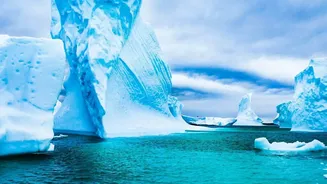





A Tale of Two Antarcticas
To understand the new findings, it's crucial to know that Antarctica isn't a single, uniform block of ice. It’s broadly divided into two distinct regions: West Antarctica and East Antarctica. For decades, scientists have watched West Antarctica with growing
alarm. Its ice sheet is notoriously unstable, resting on a seabed below sea level, and it has been losing ice at a frightening pace. East Antarctica, by contrast, is a high, cold, and vast desert that has long been considered more stable. It holds the majority of the continent's ice, and its fate is a critical variable in long-term sea-level rise projections.
What the New Research Uncovered
A recent study published in the journal Nature has turned the spotlight onto this more stable eastern region. Researchers discovered that between 2021 and 2023, the Antarctic Ice Sheet experienced a temporary net ice gain of roughly 695 billion tons. This was the largest short-term mass gain ever recorded by GRACE satellites, which have been monitoring the continent since 2002. The cause was not a sudden cold snap, but exceptionally heavy snowfall over a specific part of East Antarctica. This finding initially seems like good news, but the reason behind the dump of snow is far more complex and tied to warming trends elsewhere on the planet.
The Tropical Connection Paradox
Here is the paradox: the record snowfall was triggered by warming, not cooling. Scientists traced the event to a patch of unusually warm ocean water thousands of kilometres away in the tropical Pacific and Indian Oceans. This sustained warmth generated a massive atmospheric disturbance, known as a Rossby wave train, that funnelled huge amounts of moisture towards the frozen continent. This phenomenon essentially acted like an atmospheric river, delivering sustained, heavy snowfall to East Antarctica. So, while the ice sheet gained mass, the event was a direct consequence of warming patterns in other parts of the world, highlighting the deeply interconnected nature of our global climate system.
A Temporary Buffer, Not a Reversal
Scientists are clear on one point: this is a temporary event, not a long-term reversal of Antarctica's melting trend. Over the past two decades, the continent has still lost ice at an average rate of about 140 billion tons per year. The massive snowfall in the east temporarily slowed this overall decline but did not stop it. Losses in West Antarctica continued unabated. This event serves as a powerful reminder that natural climate variability can create significant short-term changes. While the added snow did act as a temporary buffer against sea-level rise, it is not evidence that the climate crisis is abating. Instead, it shows how a warming world can produce unexpected and seemingly contradictory outcomes.
Why It Matters for India's Coastline
For a nation like India, with a vast 7,500-kilometre coastline and densely populated coastal cities like Mumbai, Chennai, and Kolkata, what happens in Antarctica is not a distant problem. Even small fluctuations in the rate of sea-level rise have profound implications. The long-term melting of Antarctica's ice sheets remains one of the single biggest threats to these coastal communities. While the recent snowfall offered a brief reprieve, the overall trend of ice loss continues. This study underscores the urgent need to understand these complex climate connections to refine sea-level rise models and prepare for the future. It demonstrates that the stability of our coastal cities is linked to events happening in the coldest, most remote corners of our planet.