




A Signal from the Dawn of Time
Astronomers using the James Webb Space Telescope (JWST) have been studying one of the most distant and ancient galaxies ever observed, known as GN-z11. We are seeing it as it was just 400 to 430 million years after the Big Bang. What's puzzling scientists
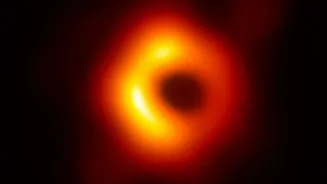
is its extraordinary brightness. The source of this intense energy has led to some fascinating theories. While one team of researchers found evidence of a supermassive black hole at its centre, gobbling matter at an astonishing rate, the sheer size and luminosity of such an early object has also opened the door to another, more exotic possibility: a 'black hole star'.
Meet the 'Quasi-Star'
So, what exactly is a 'black hole star,' or quasi-star? It is a hypothetical type of colossal star that may have existed in the very early universe. Unlike stars today, which are powered by nuclear fusion in their cores, a quasi-star's immense energy would come from a black hole at its centre. The theory suggests that in the primordial universe, giant clouds of gas could collapse to form a massive protostar, potentially thousands of times the mass of our sun. The core of this object would become so dense that it collapses into a black hole, but the star’s massive outer layers would be dense enough to absorb the initial explosion and remain intact.
A Cosmic Balancing Act
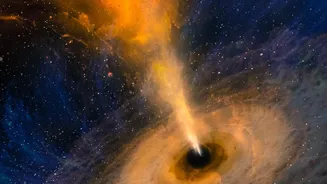
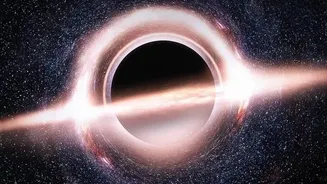
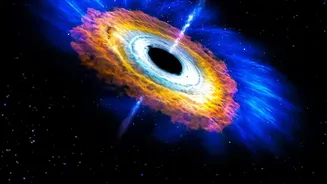
What follows is a cosmic balancing act. The newly formed black hole begins to feed on the surrounding stellar material, creating an accretion disk. As matter falls into the black hole, it heats up and releases a tremendous amount of radiation. This outward-pushing energy counteracts the inward pull of gravity, preventing the entire star from collapsing into the black hole. The result is a stable, albeit temporary, object that shines with the brightness of a small galaxy. These quasi-stars would have been enormous, with diameters potentially reaching 10 billion kilometres, but they would have had short lifespans of only a few million years before the central black hole consumed its host entirely.
Solving a Black Hole Mystery
The existence of quasi-stars could solve a major puzzle in cosmology: how supermassive black holes grew so large, so quickly in the early universe. Standard models suggest black holes form from collapsed stars and grow over billions of years. However, observations of objects like the one in GN-z11, which appears to host a black hole a few million times the mass of our sun so early in cosmic history, challenge this timeline. Quasi-stars provide a potential shortcut. They could have acted as seeds, allowing black holes to be 'born big' by starting life inside a massive stellar envelope that serves as a ready fuel source, helping them grow to supermassive status much faster than previously thought possible.