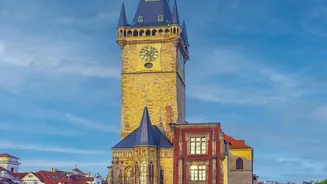




Prague: A Symphony in Stone
The story begins in Prague, a city whose beauty feels almost mythical. Its historic centre, a UNESCO World Heritage site since 1992, is a breathtaking collection of architecture spanning centuries. The journey starts, as it must, at Prague Castle. Perched
on a hill overlooking the Vltava River, this vast complex is the world's largest ancient castle area, a sprawling ensemble of palaces, churches, and gardens. Within its walls stands the awe-inspiring St. Vitus Cathedral, a masterpiece of Gothic design that took nearly six centuries to complete. From the castle's ramparts, the city unfolds below—a sea of red rooftops punctuated by the famous 'hundred spires' that define its skyline.
The Heartbeat of the Old Town
Descending from the castle, the path leads across the iconic Charles Bridge. Commissioned in 1357 by its namesake, King Charles IV, this stone bridge is an open-air gallery of 30 baroque statues, each with a story to tell. It serves as the vital artery connecting the castle district to the Old Town, which has been Prague's principal public square since the 10th century. Here, the city’s pulse is most palpable. Crowds gather before the Astronomical Clock, a marvel of medieval engineering that has been ticking since 1410. The square is flanked by the imposing Gothic towers of the Church of Our Lady before Týn and the pastel facades of historic burgher houses, creating a scene of enduring grandeur.
A Leap Across Time to the Black Sea
From the heart of Central Europe, our heritage journey makes a conceptual leap southeast, to the shores of the Black Sea. Here, nestled on a rocky peninsula in Bulgaria, lies Nessebar, a place where history is measured not in centuries, but in millennia. Connected to the mainland by a narrow man-made isthmus, this ancient city is a living museum, bearing the marks of Thracian, Greek, Roman, Byzantine, and Bulgarian civilizations. Its inclusion as a UNESCO World Heritage site in 1983 was a recognition of its incredibly dense and layered history, a stark contrast to Prague's imperial scale.
Nessebar: The Pearl of the Black Sea
Once a Thracian settlement known as Mesembria, it later became a flourishing Greek colony and an important trading post. Unlike Prague's monumental squares, Nessebar's charm is found in its narrow, winding cobblestone streets and the remains of its fortifications. But its greatest treasures are its churches. Legend claims Nessebar once had over 40 churches, and the remains of many are scattered across the peninsula. The most evocative is the Church of Saint Sofia, also known as the Old Bishopric, a 5th-century basilica that now stands in beautiful ruin, its arches open to the sky. Other structures, like the 13th-century Church of Christ Pantocrator, showcase exquisite exterior decoration with brickwork and ceramic inlays, a testament to the city’s prosperity during the Second Bulgarian Empire.
Two Chapters of a European Story
Walking through Nessebar is a different experience from navigating Prague. Where Prague's history is one of imperial power and artistic movements on a grand scale, Nessebar's is a story of resilience, trade, and faith on a windswept coast. The town is a tapestry of wooden houses from the 19th-century Bulgarian Renaissance leaning against medieval Byzantine church walls. This blend of domestic architecture and sacred ruins creates an atmosphere of intimate history. While Prague awes with its scale and preserved completeness, Nessebar captivates with its fragments and the powerful sense of time passing. The former is a perfectly preserved symphony; the latter is a collection of beautiful, echoing whispers.