



The Paradox of Earth's 'Evil Twin'
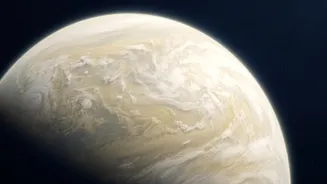
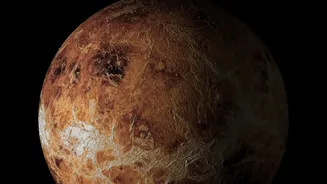
For decades, Venus has been a story of contrasts. It’s our closest planetary neighbour and similar in size to Earth, yet its path of evolution diverged dramatically. Today, it’s a scorching, inhospitable world with a dense atmosphere of carbon dioxide
and clouds laced with highly concentrated sulfuric acid. The pressure on its surface is over 90 times that of Earth's, and temperatures average a staggering 470 degrees Celsius. These extreme conditions led many scientists to dismiss it as a viable target in the search for extraterrestrial life. But a tantalising question has always remained: was it always this way? And could something be surviving in the one place that isn't quite so hellish—its upper cloud layer?
A Surprising Discovery in the Clouds
The most recent and exciting developments come not from a spacecraft, but from a laboratory at MIT. Researchers simulated the conditions inside Venus's famously corrosive clouds to see how the fundamental building blocks of life would fare. The results, published in the Proceedings of the National Academy of Sciences, were stunning. They found that peptides—short chains of amino acids that are the foundation of proteins—can survive in 98% sulfuric acid. Not only did they remain stable for weeks, but they also folded into well-defined 3D structures. This is a critical finding because a molecule's shape determines its function. While this is not a detection of life, it challenges the long-held assumption that Venus's clouds would instantly destroy any complex organic molecules, opening the door for new theories on planetary habitability.
What Exactly Is Prebiotic Chemistry?
This new research is a significant step in the field of prebiotic chemistry. This branch of science isn't about finding existing life but rather understanding the chemical steps that lead to it. It explores how simple, non-living molecules like ammonia and methane can react to form complex organic compounds like amino acids, lipids, and the components of RNA and DNA. Think of it as the chemical recipe that must be followed before life can emerge. Scientists believe that comets and meteorites could have delivered these precursor molecules to early Earth, kick-starting the process. Finding that these ingredients can form and remain stable in environments as extreme as interstellar space or Venus’s clouds dramatically expands the range of places where life might originate.
A Lost Water World?
The potential for prebiotic chemistry on Venus is bolstered by theories that the planet may have once been much more hospitable. Several models suggest Venus could have had oceans and an Earth-like climate for billions of years before a runaway greenhouse effect took hold. Some recent geological studies propose that certain surface features on Venus could be the remnants of ancient shorelines, though this interpretation is still debated. Other models suggest Venus's water may have been lost much earlier in its history. The question of Venus's watery past remains one of the biggest mysteries in planetary science. If it did have oceans, it would have had a crucial ingredient for life as we know it, making the survival of prebiotic molecules in its present-day atmosphere all the more significant.
Skepticism, Debate, and Future Missions
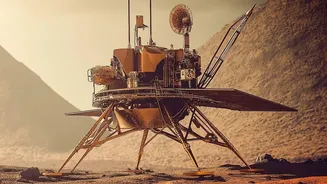
It's important to note that these findings are part of an ongoing scientific debate. The famous 2020 detection of phosphine gas—a potential biosignature—in Venus's clouds remains heavily contested. And the MIT study is a lab experiment, not a direct discovery of peptides on Venus. What it does is prove that one major barrier to life's chemistry might not be as insurmountable as we thought. To get definitive answers, we need to go there. A fleet of new missions is planned for the late 2020s and early 2030s. NASA's DAVINCI probe will plunge through the atmosphere, analysing its composition, while the VERITAS orbiter will map the surface in detail. ESA's EnVision will also study the planet from orbit, and a private mission from Rocket Lab plans to send a probe directly into the clouds as soon as 2026 to search for organic molecules.