



India’s first-ever solar observatory, Aditya-L1, is already rewriting our understanding of the Sun. A recent, groundbreaking observation has challenged long-held assumptions about solar eruptions, marking a major milestone for ISRO and global space science.
A Major Milestone for Indian Space Science
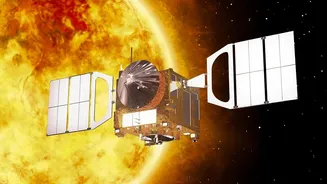
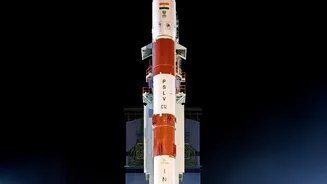
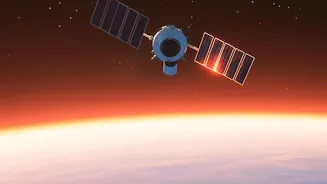
Since its launch in September 2023, the Aditya-L1 spacecraft has been on a historic journey, positioning itself at a unique vantage point 1.5 million kilometres from Earth. From this spot, known as Lagrange Point 1 (L1), it gets an uninterrupted view of our star. This mission represents a giant leap for the Indian Space Research Organisation (ISRO), moving beyond lunar and Martian exploration to stake a claim in the complex field of heliophysics. The primary goal is to understand the Sun’s behaviour and its impact on the solar system, an area of science collectively known as space weather.
What Aditya-L1 Actually Witnessed
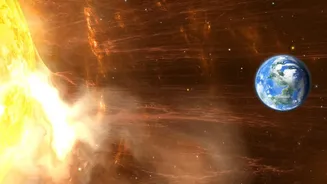
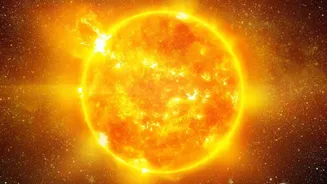
Scientists from the Indian Institute of Astrophysics (IIA) have used Aditya-L1 to get a revolutionary new look at a Coronal Mass Ejection (CME). CMEs are colossal explosions of plasma and magnetic fields from the Sun's outer atmosphere, the corona. The specific event, observed on August 5, 2024, was captured in unprecedented detail by the Visible Emission Line Coronagraph (VELC), the mission's primary instrument. By combining VELC's data with observations from NASA's Solar Dynamics Observatory (SDO) and sophisticated 3D modelling, the team discovered that the eruption was not a perfect, expanding bubble as previously thought. Instead, it was tilted and expanded unevenly.
Deconstructing a 'Tilted' Solar Storm
For decades, most models of CMEs assumed they expanded symmetrically, like a balloon being inflated. Aditya-L1's findings turn this idea on its head. The key was the VELC instrument's ability to perform Doppler spectroscopy. This technique, similar to how a traffic speed gun works, measures shifts in light to determine if plasma is moving towards or away from the observer. During the August 2024 event, VELC detected some material moving towards it and other material moving away simultaneously. This could only be explained by a model where the CME was expanding asymmetrically and was tilted. A simple, uniform bubble model just didn't match the data.
Why This Changes Everything for Space Weather
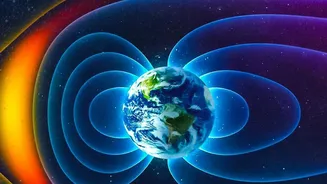
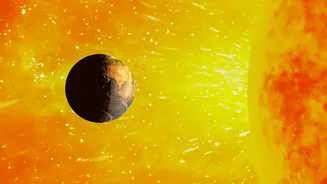
This discovery isn't just an academic detail; it has profound implications for predicting space weather. CMEs are the primary cause of major geomagnetic storms on Earth. These storms can disrupt and damage satellites, interfere with GPS and communication networks, and even cause massive power outages on the ground. The shape of a CME is crucial because it affects how it travels through space. An unevenly shaped eruption will experience different amounts of drag from the solar wind—the constant stream of particles flowing from the Sun. This can change the CME's speed and, critically, its arrival time at Earth. Predicting its arrival accurately is essential for giving operators time to protect vulnerable systems.
A New Era of Solar Forecasting
By proving that CMEs can be lopsided, Aditya-L1 has provided a crucial new piece of the puzzle. It shows that relying on imaging from a single viewpoint isn't enough. The ability of the VELC instrument to measure motion along the line of sight provides a way to reconstruct the threendimensional structure of an eruption even from a single observatory. This capability is a game changer, promising to make our forecasts of solar storms more accurate. It reinforces the mission's role as a vital early warning system, standing guard against the Sun's violent outbursts and helping to safeguard our increasingly technology dependent world. The findings from this one event will now be applied to other CMEs to build more robust and reliable models.