







That rich, aromatic coffee bean you grind for your morning brew holds a surprising secret. It isn't a bean at all. Botanically speaking, it's the seed of a colourful fruit, embarking on a remarkable journey before it ever reaches your cup.
Meet the Coffee Cherry
Long before
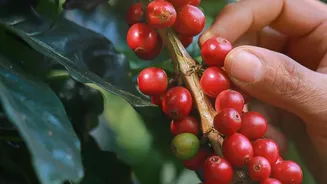
it becomes a dark, roasted 'bean', your coffee starts its life as a flower on a shrub-like plant called Coffea. These delicate white blossoms, which smell a bit like jasmine, eventually give way to a fruit. This fruit is known as a coffee cherry, and it grows in clusters, ripening from a bright green to a deep, glossy red or sometimes yellow, depending on the variety. Like cherries or plums, the coffee cherry is a type of fruit called a drupe, or stone fruit. But unlike those fruits, the most prized part of the coffee cherry isn't the sweet flesh, but what lies within: the seed. Most cherries contain two seeds, nestled flat-side against flat-side.
The Anatomy of a Fruit
If you were to dissect a ripe coffee cherry, you would find several layers. On the very outside is the tough skin, or exocarp. Beneath that is the pulp, a sweet, sticky layer of fruit flesh called the mesocarp. This pulp is edible and has a pleasant, sweet taste, though there isn't much of it. Deeper still is a slimy layer called the mucilage, and then a papery, parchment-like layer known as the endocarp, which forms a protective hull around the seeds. Finally, encasing each seed is one last delicate layer called the silverskin. The two seeds at the very centre are what we call coffee beans. So why do we call them beans? Simply because of their resemblance to true beans, like kidney or pinto beans, which are part of the legume family. Botanically, however, they are not related.
From Seed to a Sip
Getting the seed out of the fruit is a critical step known as processing, and it has a huge impact on the final taste of your coffee. There are three main methods. The 'natural' or 'dry' process is the oldest method, where whole coffee cherries are spread out to dry in the sun for several weeks. The fruit husk is removed after drying, a process that can impart intense, fruity flavours to the bean. The 'washed' or 'wet' process removes the skin and pulp from the seed before drying. The seeds are fermented in water to break down the sticky mucilage layer, then washed and dried. This method often results in a cleaner, brighter, more acidic cup of coffee. A hybrid method, known as the 'honey' or 'pulped natural' process, involves removing the skin but leaving some or all of the sticky mucilage on the seed as it dries, creating a flavour profile that's often sweeter and has more body than a washed coffee.
Why the Fruit Matters
Understanding that coffee is a seed from a fruit helps explain why coffees from different regions taste so different. The variety of the coffee plant, the soil it grows in, the altitude, and the climate all affect the development of the sugars and acids within the cherry. These compounds are the building blocks of flavour. During processing, especially in natural and honey-processed coffees, the sugars and other compounds in the fruit pulp can be absorbed by the seed, contributing to the final taste. A well-ripened cherry has more sugar, leading to a sweeter and more complex coffee. This is why careful harvesting, where only the ripe cherries are picked by hand, is a hallmark of specialty coffee production. The journey from a vibrant fruit to a roasted seed is what gives each coffee its unique character.