








More Than Just a Kitchen Accessory
Many see a range hood, or chimney, as a standard part of a kitchen's look. But its primary job is functional and vital for a healthy home. Every time you cook—whether you're tempering spices for a dal, frying puris, or searing vegetables—you release a cocktail
of substances into the air. This includes smoke, grease particles, steam, and odours. A quality range hood is designed to capture these airborne byproducts at their source, preventing them from settling on your cabinets, walls, and furniture. By whisking away these particles, it drastically improves your kitchen's air quality, controls excess heat and moisture, and keeps your space cleaner for longer.
The Science of Suction and Airflow
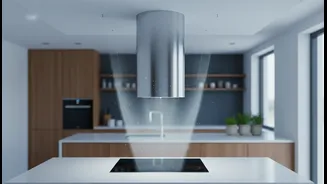
A range hood works by using a fan to create a low-pressure zone, sucking the air and pollutants from above your cooktop into its filters. For this to happen effectively, the air must have a clear, unimpeded path to the hood's intake vents. Any obstruction acts like a dam in a river, disrupting the flow. If cabinets, decorative trim, or even a poorly designed shroud block the path, the fan's suction power is wasted. It might be spinning powerfully, but it can't capture the smoke and grease plume efficiently. The pollutants then escape around the sides and spill into your kitchen, defeating the entire purpose of having a hood in the first place.
The Problem with Crowding Cabinets
In the quest for maximum storage, it's tempting to install cabinets as close to the range hood as possible. This is a common and critical installation mistake. When cabinets are too close, they physically block the capture area of the hood. This is especially true for under-cabinet models. The hot air, steam, and grease that should rise directly into the filter instead hit the underside of the adjacent cabinets. This not only reduces the hood's efficiency but can also damage your cabinetry over time from exposure to moisture and heat. It also creates a fire hazard, as grease can accumulate on these nearby combustible surfaces.
Getting the Installation Right
Proper installation is the single biggest factor in your range hood's performance. The key is ensuring adequate clearance. Most manufacturers recommend a distance of 24 to 30 inches (about 60 to 76 cm) between the bottom of the hood and the surface of an electric or induction cooktop. For gas stoves, which produce more heat, a slightly greater clearance of 24 to 36 inches is often advised to prevent heat damage. Crucially, the hood should also be at least as wide as your cooktop, and ideally a few inches wider on each side, to ensure it can capture everything that rises from the cooking surface. Always check your specific model's installation manual, as it will provide the precise measurements for optimal and safe operation.
What About Ductless Hoods?
You might think this only applies to ducted hoods that vent air outside. However, ductless (or recirculating) models are just as dependent on clear intake airflow. These hoods work by pulling air through charcoal filters to remove odours and grease before releasing the air back into the kitchen. If the intake is blocked by cabinets, the unit cannot pull in a sufficient volume of air to filter effectively. The result is the same: poor removal of pollutants, lingering cooking smells, and a greasy film building up in your kitchen. No matter the type, the principle remains: the air needs a clear path in.
How to Check Your Current Setup
Take a quick look at your own kitchen. Does your range hood seem cramped? Is it significantly narrower than your stovetop? Are the surrounding cabinets almost touching its sides? Turn the fan on high and light a stick of incense or a match (safely) below it. Does the smoke get pulled directly and swiftly into the vents, or does it swirl and escape into the room? If it’s the latter, you likely have an airflow problem. This could be due to a blocked filter needing a clean, or it could be an improper installation with inadequate clearance from surrounding objects.