


A Violent Cosmic Meal
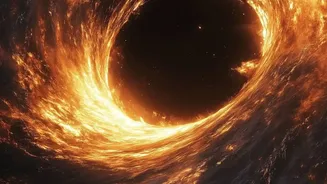
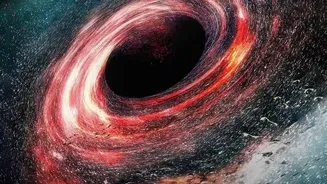
When a star ventures too close to a supermassive black hole, it’s a violently one-sided encounter. The black hole's immense gravitational pull creates intense tidal forces that stretch and ultimately shred the star into streams of gas, a process fittingly
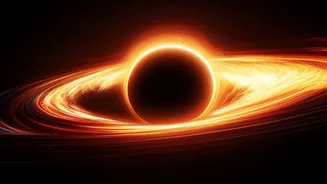
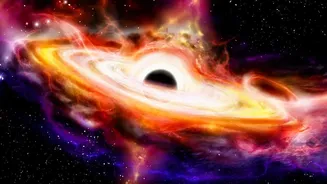
known as 'spaghettification.' As this stellar material gets pulled into a swirling disk around the black hole, it heats up and releases a brilliant flare of light that can outshine all the stars in its host galaxy. This dramatic phenomenon is called a Tidal Disruption Event, or TDE. These events are rare, happening perhaps once every 100,000 years in a given galaxy, but they provide a unique opportunity for astronomers. Since black holes themselves are invisible, a TDE acts like a temporary flare, illuminating the location of an otherwise hidden cosmic monster.
An Unexpected Location
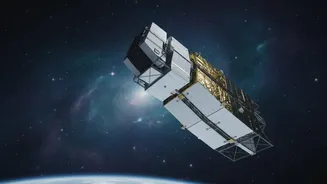
For decades, astronomers have found these TDEs almost exclusively in one place: the very center of galaxies. That's where we expect to find supermassive black holes, the gravitational anchors holding everything together. However, a recent discovery, confirmed with the help of NASA's Neil Gehrels Swift Observatory, has broken this pattern dramatically. An event dubbed TDE 2025abcr was spotted not in the bustling core of its galaxy, but in the quiet suburbs, tens of thousands of light-years away from the center. It is one of the most distant 'off-center' TDEs ever recorded, revealing a massive black hole, estimated to be a million times the mass of our sun, wandering far from its expected home. The discovery was first flagged by the Zwicky Transient Facility (ZTF) in California, which uses artificial intelligence to scan the night sky for unusual flashes of light.
The Galactic Merger Hypothesis
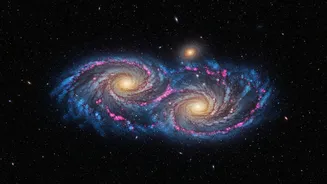
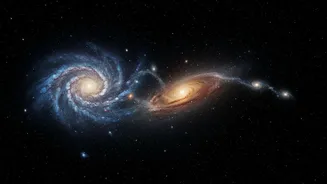
So how does a million-solar-mass black hole end up wandering in the galactic hinterlands? The leading theory involves ancient, cataclysmic collisions. Our universe is a place of constant evolution, where galaxies often merge and collide. During these chaotic dances, the supermassive black holes at their centers can interact in complex ways. One possibility is that the smaller black hole from a merging galaxy gets a gravitational kick, flinging it out of the newly combined galactic core. Another is that a close pass between two massive black holes ejects one of them into a wide, looping orbit. This 'wandering' black hole would then travel invisibly through its galaxy for eons, a ghost in the machine, until it happens to pass close enough to a star to trigger a TDE, briefly giving away its position.
Why This Discovery Matters
Finding a TDE so far from a galactic center is more than just a cosmic curiosity; it's a crucial piece of evidence that confirms long-held theories. It provides the first concrete proof for many astronomers that wandering supermassive black holes exist and can be found by looking for these off-center flares. This single event helps astronomers test their models of how galaxies evolve through mergers. It suggests there could be a hidden population of massive black holes roaming the outskirts of galaxies, remnants of a violent past. The NASA Swift Observatory played a critical role in confirming the nature of the flare, with its ability to observe in ultraviolet light, where TDEs shine brightly. For a few months, this single event outshone its entire host galaxy in UV wavelengths. This new technique of looking for off-center TDEs has validated a new way to hunt for these elusive objects.