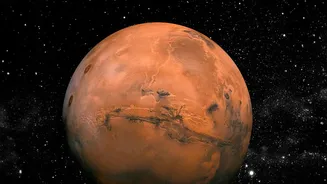







The Red Planet’s Watery Past
For decades, missions to Mars have sent back tantalising evidence of a world that was once much more like Earth. Images reveal dried-up riverbeds, ancient lake deltas, and vast plains shaped by flowing water. We know that billions of years ago, Mars was a warmer,
wetter place. The mystery, however, has always been in the details of its decline. Did a cataclysmic event cause the water to disappear suddenly, or was it a slow, drawn-out process? Answering this is crucial to understanding not just Mars's history, but also whether life ever had a chance to get started there. Piecing together this planetary timeline is like forensic science on a cosmic scale, and scientists have been searching for a reliable clock buried in the Martian rock.
A Mineral Clue Called Hematite
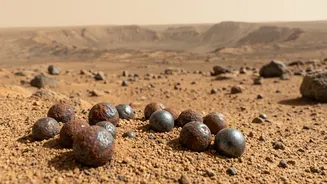
Enter hematite, a form of iron oxide. You know it better as rust. On Earth, hematite commonly forms in the presence of water, so its discovery on Mars was a landmark moment, confirming the planet's aqueous past. NASA's Opportunity rover famously found tiny hematite spherules, nicknamed 'blueberries', which pointed to a history of groundwater. But this new research, based on data from the Curiosity rover in Gale Crater, goes a step further. Scientists are now looking not just at the presence of hematite, but at its very structure—the size of its individual crystals—to unlock a more detailed story. It turns out that not all hematite is created equal, and the differences can tell us about the conditions under which it formed.
Reading the Crystal Timeline
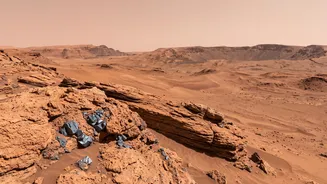
In a recent study, scientists analysed 20 rock samples drilled by Curiosity at different elevations within Gale Crater. Since deeper rock layers are older, climbing the crater walls is like travelling forward through Martian history. They discovered a fascinating pattern: in the older, deeper layers, the hematite crystals were significantly larger, some up to 65 nanometers. In the younger, upper layers, the crystals were tiny, usually less than 10 nanometers. This difference in size is a powerful mineralogical marker. The larger crystals in the older rocks could only have formed through a process that requires persistent, warm, and wet conditions over millions of years. This suggests that long after the Martian surface began to cool and dry, warm groundwater continued to exist in the subsurface.
From Warm Groundwater to Frozen Desert
The findings paint a picture of a slow, gradual transition. The tiny crystals in the younger rocks, found alongside another mineral called goethite, point to a much colder and drier environment where water was scarce. Essentially, the surface of Mars was freezing over. But deep underground, the planet’s story was different. The research suggests that warm, wet conditions could have persisted in the subsurface of Gale Crater for as long as 4.7 million years, even as the surface lakes vanished. Instead of the water disappearing all at once, it retreated underground, creating long-lasting aquifers that were sheltered from the harsh surface conditions.
A Longer Window for Life?
This discovery has profound implications for the search for ancient Martian life. A gradual drying process, with a long-lasting sanctuary of underground water, provides a much longer window of opportunity for life to have potentially emerged and survived. While this doesn't prove that life ever existed on Mars, it extends the timeline for when the planet could have been habitable. The hematite crystals act as a 'time machine', allowing us to see that the change from a blue, potentially habitable world to the red desert we see today was not an overnight event. It was a long goodbye, with the last reservoirs of water holding out for millions of years deep within the rock.