





The Invisible Cosmic Barrage
Space is not empty. Beyond the perceived calm, our solar system navigates a galaxy filled with galactic cosmic rays (GCRs) — tiny, charged particles accelerated to nearly the speed of light by violent cosmic events like supernovae. These particles, mostly
protons and atomic nuclei, are a major concern for space exploration. Unshielded, they can damage spacecraft electronics and pose a significant health risk to astronauts on long-duration missions, such as those planned for the Moon and Mars. On Earth, we are largely protected by our planet's magnetic field and atmosphere, but as humanity pushes further into space, understanding this radiation is no longer an academic exercise; it's a critical safety requirement. The key to our protection is a massive magnetic bubble inflated by the Sun, and a new mission is giving us our best look at it yet.
Meet IMAP: Our New Cosmic Cartographer
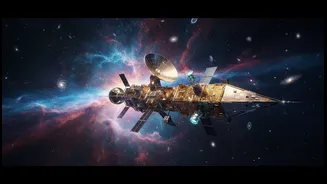
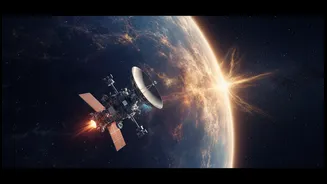
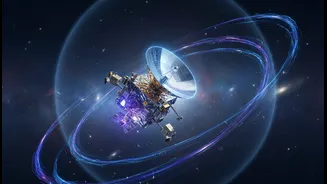
The probe at the heart of this new endeavor is NASA's Interstellar Mapping and Acceleration Probe, or IMAP. Launched in September 2025, IMAP is not a traveller in the traditional sense like the Voyager probes. Instead, it is a dedicated observer stationed at a unique vantage point one million miles from Earth toward the Sun, a gravitationally stable spot known as Lagrange point 1 (L1). After a journey of several months, IMAP reached its operational orbit in January 2026 and officially began its two-year primary science mission in February. Led by a team at Princeton University, the spacecraft, which was built and is operated by the Johns Hopkins Applied Physics Laboratory, carries a suite of ten advanced instruments designed to 'see' the invisible particles that define our cosmic neighbourhood.
Mapping the Heliosphere's Edge
IMAP’s prime directive is to map the boundaries of the heliosphere. This is the vast bubble created by the solar wind—a constant stream of particles flowing from the Sun—as it pushes against the interstellar medium, the mix of gas and dust that fills the space between stars. This bubble acts as our solar system’s primary shield, deflecting many of the galactic cosmic rays that would otherwise flood our cosmic home. IMAP will study the complex region where the solar wind collides with interstellar material, a boundary about 10 billion miles away. By detecting the particles that come from this distant interaction, scientists can create the first comprehensive 3D map of the heliosphere's structure and learn precisely how it filters and slows down cosmic radiation. The mission builds on the discoveries of predecessors like the Voyager and IBEX missions, but with instruments up to 35 times more powerful.
An Early Warning System for Earth
Beyond its primary mapping function, IMAP serves a crucial, practical purpose: improving space weather forecasting. From its perch at L1, the probe can detect solar flares and coronal mass ejections heading our way. Because it sits between us and the Sun, its data can provide roughly a 30-minute advance warning of incoming bursts of harmful radiation. This real-time information, distributed through a system called I-ALiRT, is invaluable for protecting satellites, power grids on Earth, and, most importantly, astronauts in orbit or on future lunar missions. As humanity prepares for a new era of crewed spaceflight with programs like Artemis, this early warning capability is more critical than ever, allowing time to take protective measures against sudden solar storms.