






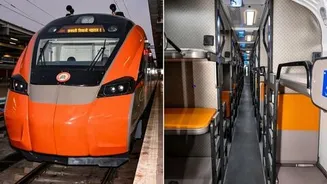
The 400km Rule Explained
The core of the new regulation is straightforward: no matter how short your journey is on a Vande Bharat sleeper train, you will be charged a fare calculated for a minimum distance of 400 kilometres. According to a Railway Board circular, this rule applies
to all classes on the train—AC First Class, AC 2-Tier, and AC 3-Tier. So, if you book a ticket for a 150km or 300km trip between two intermediate stations, your fare will still be the same as someone travelling 400km. For any distance beyond 400km, the fare will be calculated on a per-kilometre basis as usual.
How It Works in Practice
Let’s look at the base fares (excluding GST) to see the real-world impact. For any journey up to 400km, the minimum fares are set at ₹960 for AC 3-Tier, ₹1,240 for AC 2-Tier, and ₹1,520 for AC First Class. This means a passenger travelling 100km will pay ₹960 in AC 3-Tier, the same as a passenger travelling 400km. This fare structure makes very short trips on the Vande Bharat sleeper significantly more expensive than on other express trains. It is a deliberate choice by Indian Railways to position this as a premium service for long-haul overnight travel.
Why Was This Rule Introduced?
The primary reason for this rule is to prioritise long-distance passengers, for whom the train is primarily designed. Vande Bharat sleeper trains are intended to be high-speed, comfortable alternatives for overnight journeys, competing with both existing premium trains and air travel. By implementing a minimum chargeable distance, Railways discourages passengers from booking short-distance legs, which could otherwise occupy berths that a long-distance traveller might need. This ensures that the train's capacity is utilised efficiently for end-to-end or near end-to-end journeys, maximising revenue and fulfilling its core purpose as a long-haul service.
Other Key Booking Rules to Know
The 400km rule is not the only unique aspect of booking a Vande Bharat sleeper. These trains will only issue confirmed tickets. There is no provision for Reservation Against Cancellation (RAC) or waitlisted tickets, a significant departure from conventional trains. Furthermore, you won't find Tatkal or Premium Tatkal quotas available. Fares are also fixed and do not feature the dynamic or flexi-fare pricing seen on trains like the Rajdhani. The booking process itself is being nudged towards digital payments to facilitate faster refunds, which are aimed to be processed within 24 hours of cancellation.
How It Compares to Rajdhani
The Vande Bharat sleeper is priced slightly higher than the Rajdhani Express. A key difference is that Rajdhani trains do not have a similar minimum distance slab, making them a more economical choice for shorter trips on their routes. Per kilometre, the Vande Bharat sleeper is more expensive across all classes. For example, the per-kilometre rate for AC 3-Tier on a Vande Bharat sleeper is approximately ₹2.40, while on a comparable Rajdhani, it is about ₹2.10. The premium pricing on the Vande Bharat is justified by its modern amenities, faster acceleration, and potentially shorter travel times.
What This Means for Travellers
If you are planning a long-distance, overnight journey, the Vande Bharat sleeper is designed for you, offering a premium experience. However, if you are looking to cover a short distance of, say, 200-300km along its route, you need to be aware of the minimum fare rule. In such cases, checking for other available express or intercity trains on the same route might provide a more budget-friendly option. Since there is no RAC or waitlist, planning and booking in advance is crucial, especially during peak seasons, as once the confirmed berths are sold out, no more tickets will be issued for that journey.