


A New Window on Our Star
The incredible new photograph comes from the U.S. National Science Foundation's Daniel K. Inouye Solar Telescope, the most powerful solar telescope on Earth. Perched on the summit of Haleakalā in Maui, Hawaii, its massive 4-meter primary mirror allows
it to capture the sun with unprecedented clarity. While the headline credits NASA, this groundbreaking work is led by the NSF's National Solar Observatory (NSO), highlighting the collaborative nature of modern space science, where different agencies like NASA and NSF often work together to advance our understanding of the cosmos. This new observatory enables a new era of solar science, allowing researchers to see features on the sun's surface as small as 20 to 30 kilometres. This is a remarkable feat of engineering, akin to spotting an object the size of a small city from across the country.
Decoding the 'Popcorn' Surface
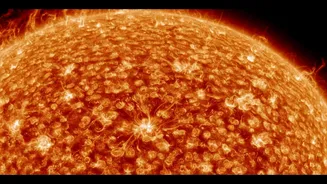
At first glance, the image looks like golden popcorn or the cells of a honeycomb. This mottled pattern is known as granulation, and it covers the entire surface of the sun. Each of these 'granules' is actually the top of a violent convection cell. Think of it like a pot of boiling water, but on a colossal scale. Hot, bright plasma from the sun’s interior rises to the surface in the center of these cells, which can be as wide as the state of Texas. As this plasma spreads out, it cools and then sinks back down into the darker, cooler lanes between the granules, creating a continuous, churning motion. This entire process is surprisingly fast; an individual granule lasts for only about 8 to 20 minutes before dissipating and being replaced by a new one.
Seeing the Unseen Swirls
This latest high-resolution view has offered more than just a clearer look at the granules. For the first time, scientists have directly observed a phenomenon known as the Kelvin-Helmholtz instability (KHI) on the sun's surface. This instability occurs when two fluids moving at different speeds slide past each other, creating swirling vortices similar to waves on water when wind blows across it. These tiny, feather-like swirls and stripes, some just tens of kilometres wide, were spotted at the edges of the granules where the cooling plasma sinks back into the sun. Previously only predicted by computer simulations, their direct observation confirms a fundamental physical process is happening on the sun's surface, which could be key to solving some of our star's biggest mysteries.
Why This Unprecedented Detail Matters
These stunning images are far more than just pretty pictures. Understanding the fine-scale physics of the sun's surface is crucial for improving our ability to predict space weather. The sun's magnetic field is the engine behind powerful events like solar flares and coronal mass ejections (CMEs). These eruptions can hurl massive amounts of energy and charged particles toward Earth, posing a threat to our satellites, communication networks, power grids, and even astronauts in space. By studying the tiny magnetic field markers and newly discovered instabilities within the granular patterns, scientists can better understand how magnetic energy builds up and is released. This detailed view provides a direct comparison for theoretical models, helping to refine the forecasts that give us critical warning time to prepare for major solar storms.