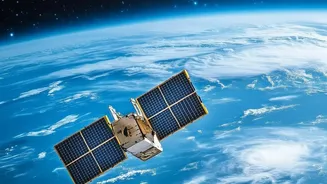









A New Eye in the Sky
Not long ago, obtaining detailed imagery from space was the exclusive domain of government agencies and their powerful, expensive satellites. Today, the field of Earth observation (EO) is undergoing a radical transformation. A growing number of private
companies have launched constellations of smaller, more affordable satellites that circle the planet, capturing vast amounts of data. This shift from a few government-owned assets to hundreds of privately operated ones has democratized access to high-resolution imagery. Companies, researchers, and even individuals can now obtain detailed, up-to-date views of almost anywhere on Earth, often with revisit rates of several times a day. This has created a boom in commercial applications, from monitoring construction progress to tracking supply chains.
The AI Magnifying Glass
The sheer volume of data produced by these satellite constellations—over 100 terabytes daily—is far too much for humans to analyze manually. This is where artificial intelligence becomes a game-changer. AI and machine learning algorithms can sift through petabytes of imagery to detect patterns, identify objects, and flag changes that would be invisible to the naked eye. Onboard AI can even allow satellites to analyze data in real-time, transmitting crucial alerts instead of raw images, saving valuable time and bandwidth. This fusion of satellite data with AI has created what some call 'geospatial artificial intelligence', or GeoAI, a powerful tool for understanding our world. For instance, AI can automatically count ships in a port, assess flood damage across a region, or monitor the health of millions of acres of farmland.
Unprecedented Benefits for a Changing Planet
The applications for this technology are vast and transformative. In agriculture, it enables precision farming, helping to optimize irrigation and fertilizer use to improve crop yields and promote food security. For environmental monitoring, satellites track deforestation, measure carbon emissions, and manage water resources with incredible accuracy. After natural disasters like floods or earthquakes, rapid access to imagery allows emergency responders to assess damage and direct aid more effectively. In the world of finance, hedge funds have used satellite data to monitor activity at retail stores to predict quarterly sales. From urban planning to insurance, the ability to get a constant, data-rich view of the planet is driving efficiency and enabling better decision-making across dozens of industries.
The Governance Vacuum: Privacy and Power
While the benefits are clear, this technological leap has outpaced the rules designed to govern it. The same tools used to track illegal fishing can also monitor military movements. The capability for real-time surveillance raises profound ethical concerns about privacy and consent, as individuals and organizations can be monitored without their knowledge. With resolutions high enough to identify individual vehicles or mailboxes, the potential for misuse is significant. Furthermore, AI systems can inherit biases from their training data, leading to discriminatory outcomes, particularly for marginalized communities. There are also national security concerns, including the risk of fake or misinterpreted satellite imagery being used as digital disinformation. This raises critical questions: Who owns this data? Who is liable for its misuse? And what happens when a private company holds more potent intelligence than a sovereign nation?
The Slow Search for Global Rules
The current legal framework for space is built on treaties from the Cold War era, like the 1967 Outer Space Treaty, which was designed for nation-states, not private corporations. Under this treaty, countries are responsible for authorizing and supervising the space activities of any private entities within their jurisdiction. This means a company is governed by the laws of its nation of origin, creating an uneven patchwork of regulations globally. International bodies like the UN's Committee on the Peaceful Uses of Outer Space (COPUOS) work to create norms, but their guidelines are often voluntary and slow to develop. There is currently no international treaty specifically governing data privacy in space, leaving a significant gap as technology advances. Experts and organizations are now calling for updated governance frameworks to address everything from data integrity to algorithmic transparency.