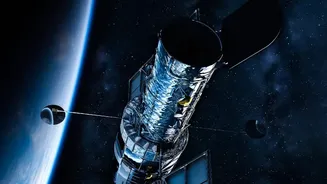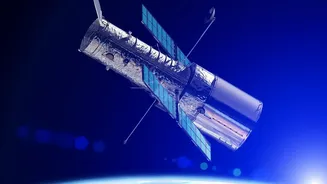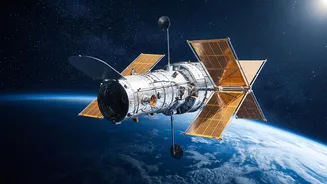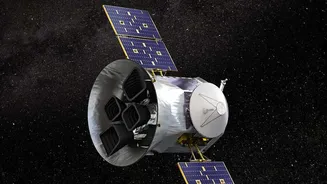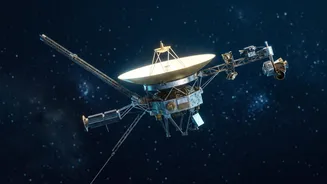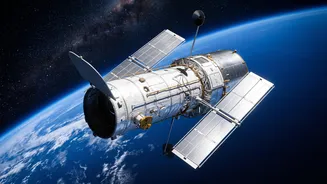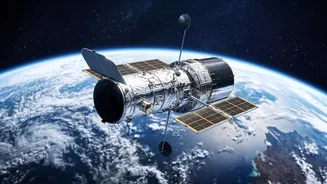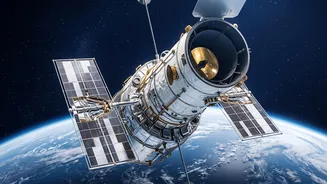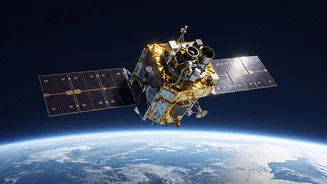



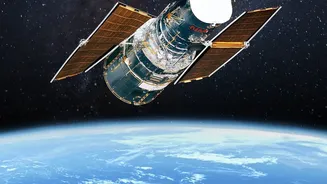
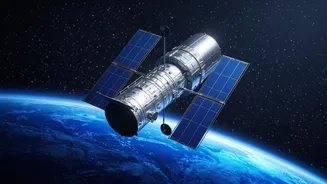
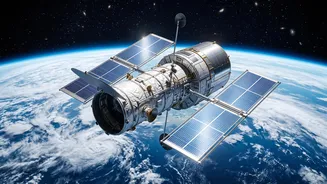
After nearly 22 years of service, one of NASA’s most agile and productive observatories has taken its final bow. NASA's Neil Gehrels Swift Observatory re-entered Earth’s atmosphere on November 4, marking the end of a remarkable era.
A Fiery Farewell
On Wednesday, November
4, the U.S. Space Force confirmed that the Swift spacecraft plunged through the atmosphere over the North Sumatra region of Indonesia. Launched in November 2004, the observatory was only designed for a two-year mission, but it vastly outlasted expectations, operating for almost 22 years. The re-entry was a result of orbital decay, a process where atmospheric drag gradually lowers a satellite's altitude. This was accelerated by recent increased solar activity, which caused Earth's upper atmosphere to expand. NASA officials noted that while most of the 3,200-pound spacecraft was expected to burn up on re-entry, it was possible some components survived the descent.
The Universe's First Responder
Swift’s primary mission was to solve the mystery of gamma-ray bursts (GRBs), the most powerful explosions in the universe. These fleeting, high-energy events often last just seconds, making them incredibly difficult to study. Swift's genius lay in its name; it was built for speed. When its Burst Alert Telescope detected a GRB, the entire observatory could autonomously pivot in under 90 seconds to focus its other instruments—an X-ray Telescope (XRT) and an Ultraviolet/Optical Telescope (UVOT)—on the fading afterglow. This rapid-response capability allowed it to capture data on these transient events faster than any observatory before it, alerting a global network of ground-based telescopes to join the observation.
A Legacy of Landmark Discoveries
Over its two-decade career, Swift detected over 2,000 gamma-ray bursts. In 2005, it provided the first ever look at the afterglow of a short GRB, confirming theories that they are caused by the collision of dense neutron stars. It also observed some of the most distant explosions ever recorded, including one from when the universe was just 630 million years old, giving astronomers a peek into the cosmos's early history. But its mission expanded far beyond GRBs. Swift became an all purpose 'astronomical multitool', studying everything from supernovae and comets in our own solar system to stars being torn apart by supermassive black holes in distant galaxies. Its data has contributed to roughly 7,000 scientific papers.
A New Era of Cosmic Detection
One of Swift's most vital contributions came late in its life, with the dawn of gravitational wave astronomy. When the LIGO and Virgo observatories detect ripples in spacetime from cosmic collisions, Swift’s ability to quickly scan the sky became essential. In 2017, it was among the first to observe the ultraviolet light from a kilonova—the explosion resulting from two merging neutron stars whose gravitational waves had just been detected. This multi messenger observation, combining gravitational wave data with light, was a landmark achievement that confirmed how many of the universe’s heavy elements are forged.
An Unexpected End
The observatory's demise was not a foregone conclusion. As its orbit decayed, NASA attempted a novel rescue mission. In July 2026, a robotic servicing spacecraft called LINK, built by Katalyst Space, was launched with the goal of docking with Swift and boosting it into a higher, more stable orbit. However, the LINK spacecraft experienced attitude control problems after launch and was unable to complete the rendezvous, forcing the rescue attempt to be abandoned in August. With no propulsion of its own and the rescue mission unsuccessful, Swift's fate was sealed by gravity and atmospheric drag.