







An Idea Imported from the Desert
The journey of olive cultivation in India began not in a lab, but with an observation. In 2006, during a visit to Israel, then-Chief Minister of Rajasthan, Vasundhara Raje, was struck by the sight of flourishing olive farms in the Negev Desert, an environment
with climatic parallels to Rajasthan. This sparked the question: if olives could grow in one desert, why not another? In 2007, this idea took root with the formation of Rajasthan Olive Cultivation Limited (ROCL), a public-private partnership. The project brought together the state government, an Israeli company for its expert knowledge, and an Indian firm specializing in micro-irrigation. It was a bold attempt to introduce a lucrative, non-native cash crop to a region where farmers traditionally relied on less profitable options.
The Challenge of a New Climate
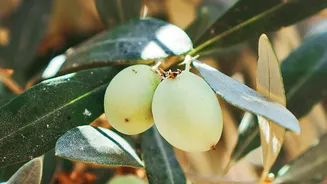
Adapting a Mediterranean native to the extremes of the Thar was a significant undertaking. While there were similarities to the Negev, Rajasthan presented its own unique hurdles, including intense summer heat, long monsoon seasons, and chilly winters. Olives require a specific period of chilling to flower properly, a condition that was not guaranteed across all of Rajasthan's diverse agro-climatic zones. The project began by importing over 112,000 saplings of seven different olive varieties from Israel, including Barnea, Arbequina, and Picual. These were planted across 182 hectares of government-owned farms in seven districts—from Jaipur and Alwar to Sri Ganganagar and Jalore—to test their viability under local conditions.
The Science of Survival and Success
Technology and scientific methodology were at the heart of the experiment's success. Advanced drip irrigation systems were crucial, delivering precise amounts of water directly to the roots and minimizing waste in a water-scarce region. An olive plant, on average, requires about 10-15 litres of water per day, a manageable amount with efficient irrigation. The project also established a high-tech nursery in Bassi, near Jaipur, with the capacity to produce millions of high-quality, disease-free saplings for farmers. Of the seven varieties initially tested, four proved particularly well-suited to the climate, yielding fruit with an oil content of around 14-15%, which meets international standards.
From Fruitful Farms to 'Raj Olive'
The first successful harvests began around 2012, proving the experiment was more than just a fleeting success. By 2014, the state was producing over 100 tonnes of olives, and a state-of-the-art refinery was established in Bikaner to process the fruit into oil. This culminated in the 2016 launch of 'Raj Olive Oil', the country's first indigenously produced olive oil brand. The project didn't just stop at oil. As some varieties struggled with flowering due to insufficient chilling hours, innovators found another use for the plants: olive tea. The leaves, rich in antioxidants, became another valuable product, with farmers selling fresh leaves to tea companies.
Challenges and the Path Forward
Despite the initial triumphs, the project has faced headwinds. In recent years, declining yields have been observed, attributed to the vagaries of climate change and irrigation issues. This has prompted the state's agriculture department to seek expertise from Spain, the world's largest olive producer, to help sustain the groves. Some farmers who adopted the crop found that fruiting was not consistent across all regions, leading to a pivot towards selling leaves and bark instead. However, for many farmers in districts like Sri Ganganagar and Bikaner, olives have presented a profitable alternative to traditional crops, with some reporting potential profits five times that of wheat per hectare.