




A 50-Year Astronomical Hunt
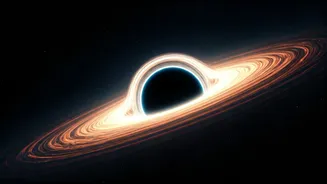
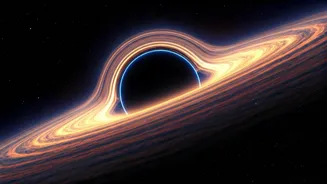
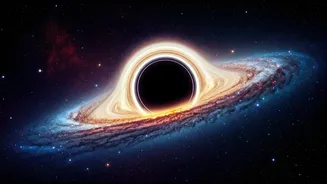
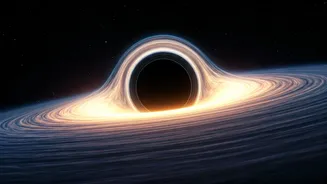
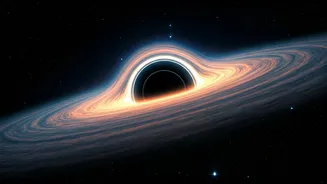
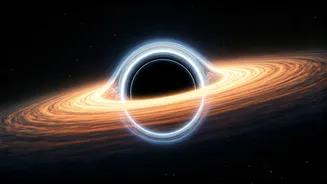
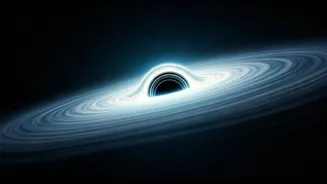
For more than half a century, astronomers have been searching for something they were sure had to exist: a wind coming from Sagittarius A, the supermassive black hole at the center of our galaxy. According to long-standing theories, any black hole that
consumes matter—even a small amount—should generate enough energy to push some of that material back out into space as an outflow, or wind. Yet, despite decades of looking, no evidence of this wind could be found at the Milky Way's core. This made our galaxy a cosmic anomaly, a strange outlier that didn't seem to play by the same rules as others. The mystery deepened with every failed search, leaving scientists to wonder what made our home galaxy so different.
The Breakthrough Discovery
The long search is finally over. In a breakthrough announcement, a team of astrophysicists from Northwestern University has confirmed the discovery of this elusive wind. Using highly detailed observations, they identified a giant, cone-shaped void in the cold molecular gas surrounding the galactic center. This cavity, which points directly back to Sagittarius A, is the clearest evidence yet of an active outflow carving its way through the surrounding material. It's the imprint of the wind that everyone had been looking for, a subtle but definite sign that our black hole is indeed exhaling, just as theories predicted. This finding resolves one of the most persistent mysteries in modern astronomy.
Not a Hurricane, but a Breeze
Unlike the violent, galaxy-shaping gales launched by black holes in more active galaxies, the wind from Sagittarius A is far more subdued. Researchers describe it as a gentle breeze rather than a cosmic hurricane. This is because our galaxy's black hole is currently in a very quiet, almost dormant phase. It consumes so little material that its diet has been compared to a human eating a single grain of rice every million years. Because it feeds so little, its resulting outflow is weak and was incredibly difficult to detect through the dense gas and dust of the galactic plane. Based on the size of the cavity it has created, astronomers estimate this gentle wind has been blowing for at least 20,000 years.
High-Tech Telescopes and New Techniques
Detecting such a faint signal required immense precision and cutting-edge technology. The discovery was made possible by using the Atacama Large Millimeter/Submillimeter Array (ALMA) in Chile, one of the most powerful radio telescopes in the world. The research team, led by Mark Gorski and Lena Murchikova, analyzed over 100 hours of observational data collected between 2017 and 2021. By using a new calibration technique to filter out the overwhelming noise from the black hole itself, they were able to reveal the subtle signature of the wind's impact on the surrounding cold gas. Overlaying this data with X-ray observations from NASA's Chandra Observatory gave them the confidence that what they were seeing was a real phenomenon, not just a fluke in the data.
Solving the Puzzle of Our Place
This discovery does more than just solve an old mystery; it fundamentally refines our understanding of the Milky Way. It confirms that Sagittarius A is not unique or peculiar but behaves just like other supermassive black holes, simply on a much quieter scale. The wind, though gentle, still actively shapes its immediate environment, clearing out gas and influencing the conditions at the very heart of our galaxy. It demonstrates that even a sleeping giant of a black hole has a constant, subtle influence. This finding provides a crucial new window into the physics at play in the galactic center and brings our picture of the Milky Way's life cycle into sharper focus.