

A Cosmic Lion's Roar
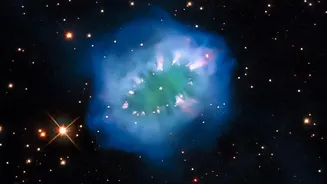
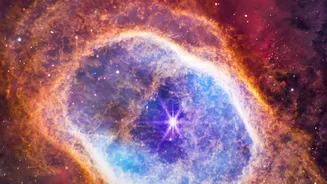
The latest subject of Webb’s intense gaze is NGC 2392, a planetary nebula nicknamed the Lion Nebula for its striking resemblance to a lion's head, complete with a flowing mane. While NASA's Hubble Space Telescope first captured its face-like shape in visible
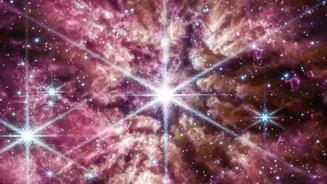
light back in 2000, Webb's new image provides a much sharper, more detailed view. Captured in infrared light, the image reveals intricate structures and hidden details within the clouds of gas and dust that were previously invisible. What we see is not a peaceful scene, but the turbulent aftermath of a star's death, a process that has been unfolding for several thousand years. The nebula's magnificent mane is made of filaments and hazy, comet-shaped objects that are constantly changing under the influence of the central star.
Anatomy of a Dying Star
At the heart of the Lion Nebula, appearing like a bright button nose, lies the remnant of a dying star similar to our own Sun. Stars of this mass don't explode in violent supernovas; instead, they experience a more prolonged and complex end. After exhausting the hydrogen fuel in its core, the star became unstable and began shedding its outer layers into space. This ejected material, rich in gas and dust, formed the expanding shells that now create the nebula. What remains at the center is a very hot, dense stellar core called a white dwarf. This tiny remnant is incredibly powerful, unleashing intense radiation that energizes the surrounding gas, causing it to glow and forming the intricate structures Webb has now captured.
Webb's Two-Instrument Vision
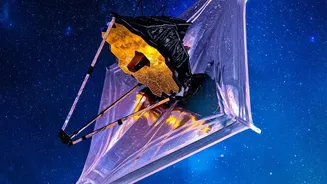
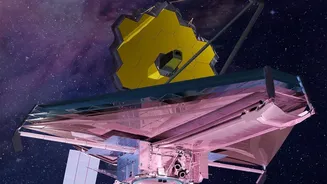
To capture the Lion Nebula in such detail, scientists used two of Webb's key instruments: the Near-Infrared Camera (NIRCam) and the Mid-Infrared Instrument (MIRI). Think of them as giving Webb two different ways to see in infrared. NIRCam specializes in shorter infrared wavelengths, perfect for seeing the finer details in the star and the structure of the expanding gas bubble that forms the lion's 'face'. MIRI, on the other hand, detects longer, mid-infrared wavelengths, which are ideal for highlighting the cooler dust. It reveals the distribution of dust throughout the nebula, showing where it is being destroyed by the star's radiation and where dense clumps manage to survive, protecting the material behind them like a shield. By combining data from both, astronomers get a complete picture of the physics at play.
A Snapshot of a Fleeting Masterpiece
The image Webb captured is a snapshot frozen in time. The process of sculpting the Lion Nebula is ongoing, with gas and dust continuing to travel away from the central white dwarf. The bubble of ionized gas that forms the lion's face is expanding, destroying dust in its path, while the surviving clumps of dust in the 'mane' create beautiful, cometary-tail-like structures. While it looks permanent to us, the nebula is a fleeting cosmic phenomenon. Astronomers estimate that in about 10,000 years—a blink of an eye in cosmic terms—the Lion Nebula will have completely dispersed into space, its materials eventually recycling into new stars and planets.