








A Crucial Test for a New Rocket Motor
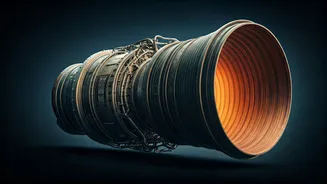
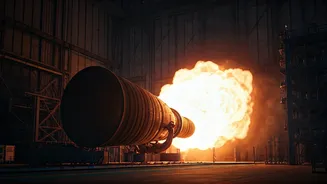
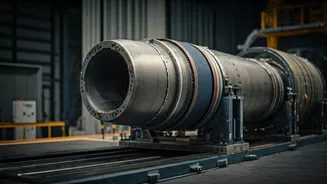
The Indian Space Research Organisation (ISRO) successfully conducted the first ground test of a new solid motor on July 3, 2026. This test was not for the main launch vehicle but for a new, dedicated rocket called the Sub-Orbital Launch Vehicle for Experiments
(SOLVE). Conducted at the Satish Dhawan Space Centre in Sriharikota, the test confirmed that the motor's performance met all expected parameters. This new vehicle is derived from the proven strap-on motors of the Polar Satellite Launch Vehicle (PSLV) but has been modified with features like a slow-burning propellant to meet the specific needs of the Gaganyaan program.
Why This Parachute Test Matters
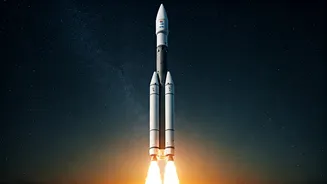
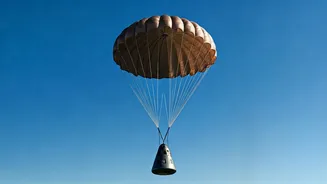
The primary purpose of the new SOLVE rocket is to test the parachute system for the Gaganyaan crew module, one of the most critical safety elements of the entire mission. During test missions, this vehicle will carry the crew module to an altitude of 10 to 17 kilometres. After separating from the rocket, a complex sequence of 10 parachutes will deploy to safely slow the module's descent before it splashes down in the sea. The successful motor test is a foundational step in validating this entire deceleration and recovery system. Having a dedicated, flexible test platform like SOLVE allows ISRO to conduct repeated trials under various conditions, ensuring the system is robust and reliable before any astronaut is on board.
Gaganyaan: India's Human Spaceflight Dream
The Gaganyaan mission is one of India’s most prestigious scientific undertakings. The goal is to demonstrate the capability of sending a crew of three astronauts into a 400-kilometre Low Earth Orbit for a three-day mission and returning them safely to Earth by landing in Indian waters. A successful mission would make India only the fourth country in the world—after the United States, Russia, and China—to have independent human spaceflight capability. The program is not just about this single flight; it's a catalyst for developing advanced technologies in life support, crew escape systems, and creating the infrastructure for future space exploration, including a potential Indian space station by 2035.
The Road Ahead: Uncrewed Flights First
Before Indian astronauts, or 'Gaganyatris', make their journey, ISRO is committed to a rigorous testing schedule that prioritizes safety above all else. The roadmap includes multiple uncrewed test flights to validate every system. The first of these missions will carry Vyommitra, a humanoid robot, to simulate a human presence and test the life-support and environmental control systems within the crew module. While initial timelines have shifted, the current plan targets the first crewed mission for 2027, following a series of two to three uncrewed validation flights starting as early as late 2026. These preparatory missions are non-negotiable steps to ensure every aspect of the flight is perfected.
Building on a Foundation of Success
This latest ground test is part of a long series of qualifications. A major milestone was the successful human-rating of the CE20 cryogenic engine, which will power the upper stage of the powerful LVM3 rocket used for Gaganyaan. This indigenously developed engine provides the immense thrust needed to propel the heavy crew module into its intended orbit. Through dozens of hot-firing tests for thousands of seconds, ISRO has ensured the engine is reliable enough for human spaceflight. Each successful test, from the powerful engines to the life-saving parachutes, builds the confidence and technical maturity required for this monumental national endeavour.