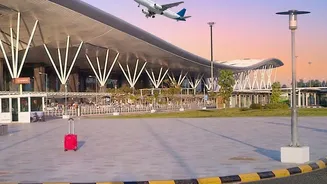









What is the Two-Year Airport Plan?
The West Bengal government and the Union Civil Aviation Ministry have signed an agreement to fast-track the development of four new airports across the state. The project, which falls under the Centre's UDAN regional connectivity scheme, aims to make
air travel more accessible and stimulate economic growth in underserved areas. Union Civil Aviation Minister K. Rammohan Naidu announced the aggressive two-year timeline, highlighting that this initiative intends to double the number of airports in West Bengal from four to eight. The Centre has also committed to spending ₹29,000 crore in the state over the next decade to bolster air connectivity.
Spotlight on the Four Locations
The plan strategically targets different regions of the state for development. The four locations are Chharra in Purulia, Balurghat in Dakshin Dinajpur, and civil enclaves at two existing Air Force stations: Kalaikunda in Paschim Medinipur and Hasimara in Alipurduar. The plan for Kalaikunda and Hasimara involves creating civilian terminals to allow passenger flights to use the existing military runways, which are long enough to support narrow-bodied aircraft like the Airbus A320 and Boeing 737. At Balurghat, the existing airstrip will be expanded. A new airport is slated for construction at Chharra, utilising a World War II-era runway.
The Push for Regional Connectivity
The primary goal behind this expansion is to enhance regional connectivity under the UDAN (Ude Desh ka Aam Nagrik) scheme. This central government initiative aims to make flying affordable and widespread by subsidising routes to underserved and unserved airports. By developing these four airports, the government hopes to connect industrial hubs, tourist destinations, and agricultural centres more effectively. For example, the Kalaikunda airport is near the industrial town of Kharagpur, while the Hasimara enclave could boost tourism in the Dooars region. The airport at Chharra could also serve industrial cities in neighbouring Jharkhand.
Reviving and Upgrading Old Airstrips
Many of these projects are not starting from scratch but involve reviving or upgrading existing infrastructure. The airports at Balurghat and Chharra, for instance, have airstrips that have been largely unused for decades. The Balurghat airport is expected to become operational within a year, initially with smaller 19-seater aircraft, while land acquisition is underway for an expansion to accommodate larger ATR aircraft. Similarly, Cooch Behar airport, which has seen intermittent service, is also slated for strengthening to ensure more regular flight operations. The use of existing defence airfields at Kalaikunda and Hasimara is a cost-effective strategy, though it has faced delays in the past due to issues with land acquisition for the civilian enclaves.
Challenges and Economic Impact
While the two-year target is ambitious, the projects face hurdles. Land acquisition, a common cause of delay for infrastructure projects, remains a key challenge, particularly for the expansions at Balurghat and the development of civilian facilities at the airbases. However, officials have expressed renewed optimism about overcoming these obstacles. If successful, the economic benefits could be substantial. Improved connectivity is expected to attract investment, boost trade and tourism, create jobs, and facilitate easier movement for business and leisure travellers. The plan also includes a broader vision for the state's aviation sector, with the Centre backing a proposal for a second major airport for Kolkata in Kalyani to handle growing passenger traffic.