






The Internet's Physical Form
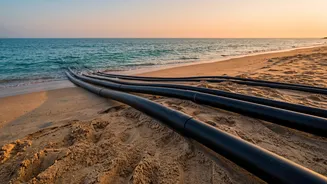
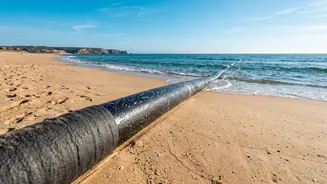
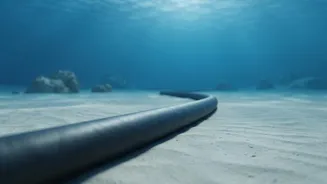
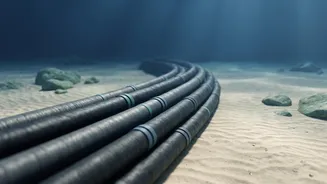
Every video you stream, every international call you make, and every bit of data from a global server travels to you through a network of submarine cables. These are not flimsy wires; they are sophisticated, garden-hose-thick bundles of fibre-optic strands
laid across the ocean floor. They form the real, physical backbone of our digital world, transmitting information as pulses of light at incredible speeds. India, as one of the world's fastest-growing digital economies, is critically dependent on this subsea architecture. While we consume about 20% of the world's internet traffic, we are connected via only about 3% of the world's cables, highlighting our massive reliance on this existing infrastructure.
Why Mumbai? The Gateway to the West
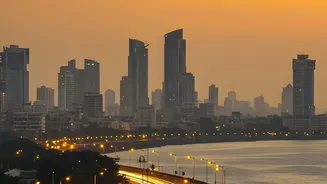
India currently has around 18 major international submarine cables connecting it to the world, landing in cities like Chennai, Cochin, Tuticorin, and Trivandrum. However, the network is not evenly distributed. An overwhelming majority of these cables—at least 13—come ashore along a small, six-kilometre stretch of coast near Mumbai's Versova area. This concentration is largely due to geography and history. Mumbai offers the most direct westward route for data traffic to the major internet hubs in Europe, the Middle East, and Africa. As India's financial capital with a long history as a telecommunications hub, it was the logical choice for early cable systems laid by companies like Tata Communications, Reliance, and Bharti Airtel.
A Single, Concentrated Point of Failure
This heavy concentration in Mumbai creates what experts call a critical vulnerability. Having most of the country's data arteries clustered in one location presents a significant risk. A single major event—be it a natural disaster like an underwater landslide, a ship's anchor dragging in the wrong place, or even deliberate sabotage—could have a massive impact. While a total internet blackout is unlikely because traffic can be rerouted through other landing points like Chennai, the performance degradation would be severe. A multi-cable failure near Versova could choke the bulk of India's international bandwidth, causing significant latency and slowdowns for everything from banking and stock markets to cloud services and AI applications.
Securing India's Digital Future
Recognizing this vulnerability, India is actively working to diversify its subsea cable infrastructure. Several new, high-capacity cable systems are being built to create more resilient networks. Projects like the India-Asia-Express (IAX), India-Europe-Express (IEX), and the massive 2Africa cable are set to quadruple the nation's internet capacity. Importantly, these new cables are landing in a more distributed manner. Chennai is being built up as a major hub for eastbound traffic to Singapore and Southeast Asia, while new landing stations are also planned for Digha, Puducherry, and Machilipatnam. Companies like Reliance Jio, Airtel, and consortiums involving global tech giants like Meta and Google are investing heavily, not just in more cables, but in smarter, more geographically dispersed routes. These efforts aim to bypass chokepoints and build a more robust digital foundation for the future.