





A Mission of Two Halves
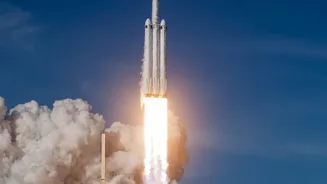
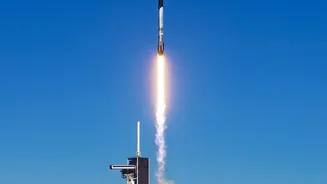
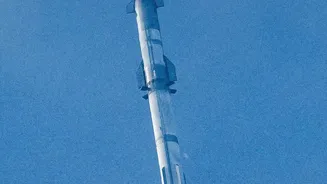
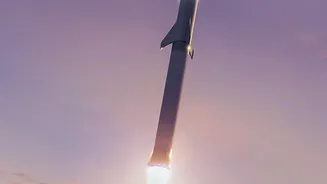
On November 13, 2026, the world's largest rocket, Starship, blasted off from its launchpad in South Texas. The mission, designated Flight 15, had an ambitious goal: to launch into orbit and then recover both of its massive stages back at the launch site.
The plan involved catching the Super Heavy booster shortly after launch and then, nearly a day later, catching the Starship upper stage as it returned from orbit. This 'double catch' was designed to prove the core concept of rapid reusability. While the launch itself was a success, the mission quickly turned into a story of mixed results. The Super Heavy booster, which was supposed to return to the tower, was instead diverted for a splashdown in the Gulf of Mexico where it was destroyed. However, the Starship spacecraft itself successfully continued to orbit, setting the stage for a history-making attempt the following day.
The 'Chopsticks' Snag a Starship
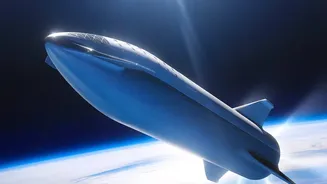
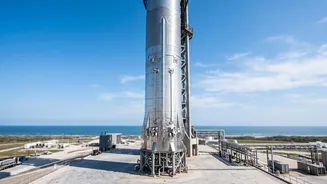
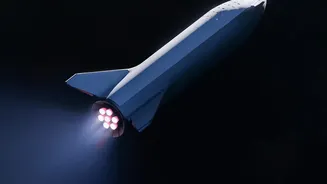
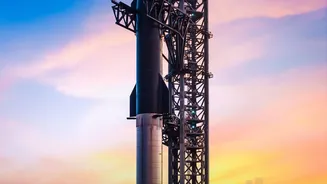
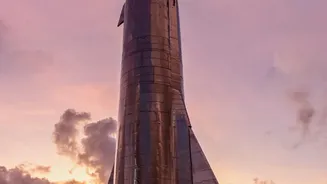
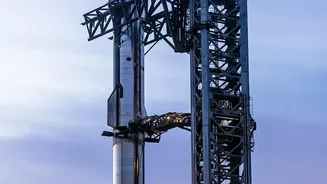
The true drama unfolded on November 14. After spending 22 hours in orbit and circling the Earth 14 times, the Starship upper stage began its fiery descent. On the ground, the giant launch and catch tower, nicknamed 'Mechazilla', waited. Its two massive mechanical arms, known as the 'chopsticks', were poised to grab the 171-foot-tall spacecraft out of the air. In a maneuver that looked like science fiction, the Starship flipped upright in the final moments of its descent, fired its engines to slow down, and positioned itself perfectly between the arms. The chopsticks closed, securing the vehicle and marking the first time in history an orbital-class spacecraft's upper stage had been caught for reuse. The success was a monumental step, validating a core, and perhaps the hardest, part of SpaceX's reusability architecture.
What Happened to the Booster?
While the Starship catch was celebrated, the failure to recover the Super Heavy booster was a significant setback for the mission's overall goal. The automated flight control system detected an issue during the booster's return burn—later attributed to a low-fuel-mass alarm—and triggered a safety abort. Instead of heading back to the tower, the booster's guidance system redirected it to a safe splashdown zone over the Gulf of Mexico, where it was intentionally destroyed moments before hitting the water. This wasn't the first time SpaceX has caught a Super Heavy booster; it had successfully done so on three previous occasions. However, the failure on this flight highlights the immense challenge of consistently executing this high-stakes maneuver and underscores that even with prior success, nothing is routine in rocket science.
Why the Catch Is a Game Changer
The entire 'catch' concept is about dramatically changing the economics of spaceflight. Landing a rocket on legs, as SpaceX's Falcon 9 does, works, but it adds weight and complexity to the rocket itself. By moving the landing hardware to the ground—in the form of the massive catch tower—the rocket can be lighter, allowing it to carry more payload. More importantly, a tower catch is the key to rapid turnaround. In theory, the same arms that catch the rocket can place it back on the launch mount for refueling and relaunch in hours or days, not weeks. This 'holy grail' of rocketry, as it has been called, is what could lower the cost of reaching orbit by orders of magnitude, making ambitions like a city on Mars and massive satellite constellations economically feasible.