


A Mission That Continues to Discover
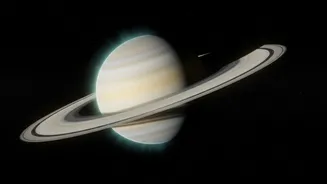
The Cassini-Huygens mission was a joint endeavor by NASA, the European Space Agency (ESA), and the Italian Space Agency (ASI). It spent 13 remarkable years orbiting Saturn, from 2004 to 2017, transforming our understanding of the gas giant, its iconic
rings, and its fascinating collection of moons. Even years after its fiery final plunge into Saturn's atmosphere, the enormous collection of data it sent back continues to be a treasure trove for scientists, leading to new discoveries that re-write our understanding of how giant planets work. A recent analysis is a perfect example, showing there is still much to learn from a mission that has long since ended.
Saturn's Lopsided Magnetic Shield
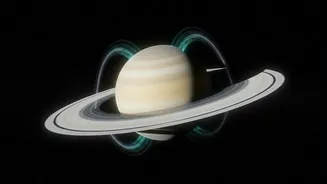
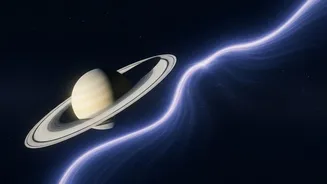
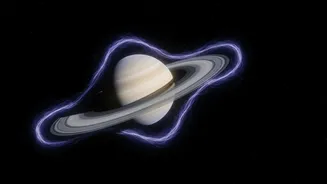
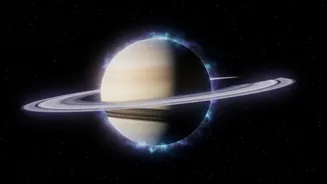
Like Earth, Saturn has a magnetosphere—a vast magnetic bubble that shields it from the constant stream of charged particles from the Sun, known as the solar wind. But that's where the similarities end. New research confirms that Saturn's magnetic shield is significantly lopsided. The culprit seems to be a combination of the planet's incredibly fast rotation—a day on Saturn is just 10.7 hours—and the massive cloud of charged gas, or plasma, that it drags along with it. Much of this plasma is supplied by its icy moon Enceladus, which famously spews water vapor from a subsurface ocean.
A Surprising Twist in the Field
The new analysis, based on six years of Cassini data, focused on a specific feature called the 'magnetic cusp'. This is a funnel-shaped opening near a planet's poles where the magnetic field lines curve back, allowing some solar wind particles to leak into the atmosphere. On Earth, this cusp is reliably located around the 'noon' position, directly facing the Sun. Scientists were stunned to find that Saturn’s cusp is dramatically different. Its rapid spin and the heavy plasma it pulls along drag the cusp far to the right, to a position between 1 p.m. and 3 p.m. on a clock face, as seen from the sun. This confirms that on giant planets, the planet's own rotation can be a more dominant force than the solar wind in shaping its magnetic environment.
Why This Discovery Matters
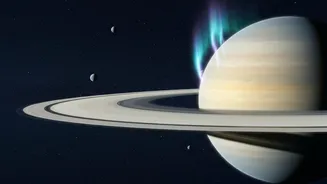
Pinpointing the location of the cusp isn't just a quirky detail; it fundamentally changes how scientists model the energetic processes within Saturn's magnetosphere. It has major implications for understanding the planet's powerful and beautiful auroras, which are sparked by particles funneled down these very cusps. It also helps explain where to expect magnetic reconnection, an explosive process that accelerates particles to incredibly high energies. According to researchers, this new understanding allows for improved theories on how all planetary magnetospheres, including those of planets far beyond our solar system, interact with their stars.
The Legacy of the Grand Finale
Much of the data enabling these breakthroughs was collected during Cassini's 'Grand Finale'. In its final months, with fuel running low, the spacecraft performed 22 daring dives into the unexplored region between Saturn and its innermost rings. This risky maneuver provided unprecedented, close-up measurements of the planet's magnetic and gravity fields, giving us a new picture of its internal structure and dynamic atmosphere. These final data points are crucial for solving lingering mysteries, such as the true length of a Saturnian day and the origins of its rings. The enduring discoveries prove the immense value of archiving mission data for future generations of scientists.