



Meet Our Galactic Neighbour
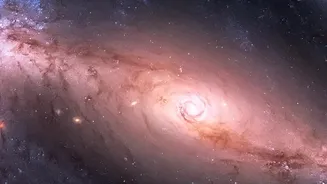
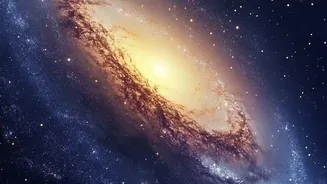
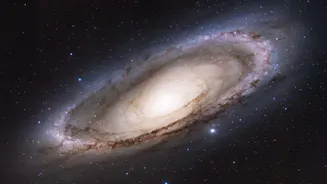
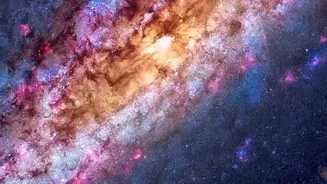
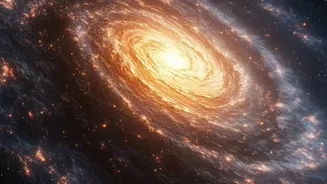
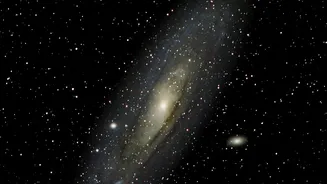
On a clear, dark night, far from city lights, you can spot a faint, fuzzy patch in the sky. That smudge is the Andromeda galaxy, the closest major galaxy to our own Milky Way. Located about 2.5 million light-years away, it’s our cosmic next-door neighbour
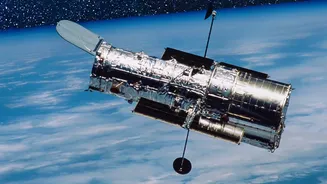
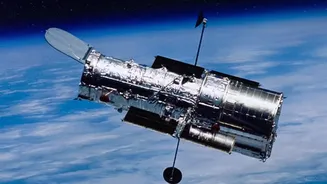
and, in many ways, a vision of our own future. Andromeda is a spiral galaxy like our own, and astronomers study it intensely because its proximity provides a unique front-row seat to galactic evolution. By watching Andromeda, we can learn about the processes that shape galaxies, including our own. It's the only large galaxy where we can resolve individual stars with telescopes like Hubble, allowing us to read its history like a 'fossil record'.
A Star Factory Winds Down
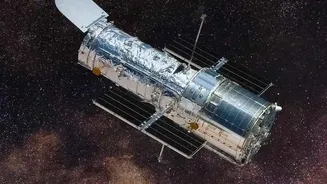
The latest news from Andromeda is both fascinating and sobering: its 'star factory' is shutting down. A new study using a vast trove of data from NASA's Hubble Space Telescope has revealed that star formation in Andromeda has been steadily declining for the last 500 million years. More dramatically, the rate has plummeted in just the last 40 million years. To put it in perspective, 500 million years ago, Andromeda was churning out new stars with a combined mass of about one of our Suns per year. Today, that rate has fallen to just one-fifth of a Sun's mass annually. The galaxy is not dead, but it is entering a quiescent, or quiet, phase of its life.
Cosmic Forensics at Work
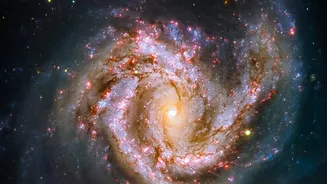
To uncover this slowdown, astronomers undertook a massive project of cosmic forensics. They used two large Hubble surveys that mapped about two-thirds of Andromeda's sprawling disc, analysing the light from approximately 200 million individual stars. The method relies on a simple principle: massive stars burn hot, bright, and blue, but have very short lives. Smaller, less massive stars are redder and live much longer. Therefore, regions sparkling with blue stars are cosmic nurseries where stars were born recently. Redder areas are galactic suburbs, populated by older, more settled stars. By dividing the galaxy into thousands of smaller sections and analysing the colour of the stars within each, the team could create a detailed timeline of star birth across the galaxy.
The Fading Ring of Fire
The decline isn't uniform across the entire galaxy. Scientists found that most of the recent star-making activity was concentrated in a huge ring about 32,000 light-years from the galactic centre. It is the fading of this specific ring that is driving much of the overall slowdown. But why is it happening? It doesn’t seem to be for a lack of fuel. Andromeda still has plenty of the gas and dust needed to create new stars. Instead, it appears to be a natural winding-down process. Around two billion years ago, Andromeda likely experienced a massive burst of star formation, possibly triggered by a collision with a smaller galaxy. What we are seeing now is the galaxy taking a 'breather' after that intense period of activity.
A Hint of Disruption
While the slowdown seems mostly natural, there may be an accomplice. Astronomers are looking closely at Messier 32 (M32), a small satellite galaxy orbiting Andromeda. By studying the history of star formation in the area near M32, researchers found a noticeable drop in activity that began around 60 million years ago. This timing could help pin down when M32 might have last punched through Andromeda's disc, disrupting its gas clouds and hampering star birth in that region. While the connection isn't confirmed, scientists have called M32 'the most likely suspect' for contributing to the local decline.
A Glimpse of the Milky Way's Future
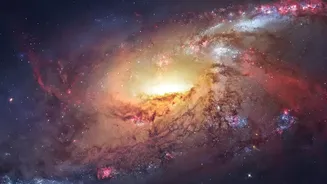
Studying Andromeda’s gentle decline is more than an academic exercise; it's a preview of what likely awaits our own Milky Way. All galaxies have a lifecycle, moving from active star formation to a quieter state. This research helps refine our understanding of how and when that transition happens. It's also a reminder of our intimate connection with Andromeda. The two galaxies are gravitationally bound and hurtling toward each other at over 100 kilometres per second. In about 4 to 5 billion years, they are predicted to collide and merge, forming a new, giant galaxy dubbed 'Milkdromeda'. The stars we see forming in Andromeda today, and those that are no longer forming, are all part of a grand cosmic story that will one day become our own.