






A Legacy of Firsts
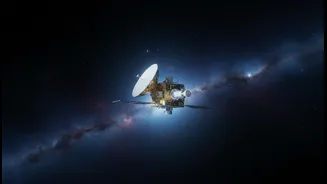
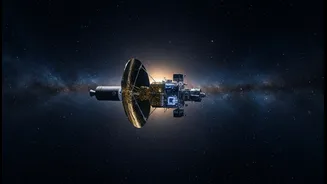
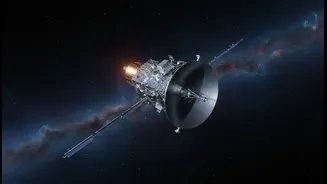
Launched in 2006, New Horizons has already earned its place in the annals of space exploration. It is the first and only spacecraft to conduct a flyby of the Pluto system, transforming the distant dwarf planet from a fuzzy dot into a complex world of nitrogen
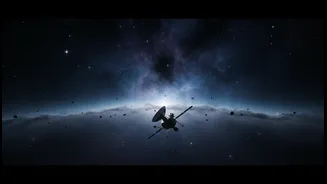
glaciers and young mountains in 2015. But it didn't stop there. In 2019, it flew past Arrokoth, a snowman-shaped object in the Kuiper Belt, making it the most distant object ever explored up close by a human-made probe. After these history-making encounters, the intrepid spacecraft has been cruising through the cold, dark expanse of the outer solar system, continuing to study its environment. In early July 2026, after a 321-day hibernation to save resources, mission controllers confirmed the probe awoke in perfect health, ready for its next chapter nearly 9.5 billion kilometres from Earth.
The Next Frontier: The Heliosphere
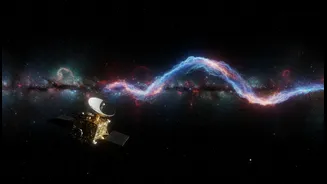
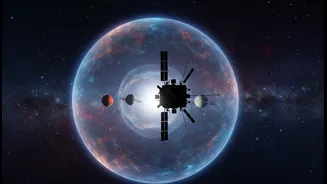
The next potential milestone for New Horizons isn’t a solid body, but a monumental, invisible structure: the heliosphere. This is the vast bubble of plasma, known as the solar wind, that our Sun blows out into space. This bubble envelops all the planets and shields our solar system from a significant amount of harsh galactic cosmic radiation. The mission's focus has now shifted to studying this region. By operating as a deep-space observatory, New Horizons is gathering unique data on the outer heliosphere from a region no other active mission is exploring. This extended mission allows it to provide an unprecedented record of conditions at the far-flung edge of the Sun's influence.
Navigating the Sun's Boundary
The edge of the heliosphere is a complex, multi-layered frontier. The first major boundary New Horizons will approach is called the 'termination shock'. This is the point where the solar wind, which has been traveling at supersonic speeds of over a million kilometres per hour, abruptly slows down as it begins to push against the matter in interstellar space. Beyond this shock is a turbulent region called the heliosheath, and at the very edge is the heliopause, where the solar wind's pressure finally balances with the interstellar medium and effectively stops. Think of it like the bow wave of a boat moving through water; the termination shock is where the water first piles up and slows before flowing around the sides.
Seeing with Fresh Eyes
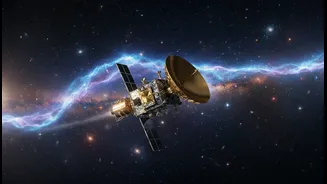
Only two spacecraft, the legendary Voyager 1 and 2 probes, have ever crossed these boundaries into interstellar space. So why is it a big deal for New Horizons to do the same? The answer lies in technology. While the Voyager probes are marvels of engineering, their instruments are from the 1970s. New Horizons is equipped with a more modern and sensitive suite of scientific instruments. It can make measurements the Voyagers couldn't, particularly of particles called 'pickup ions' that are crucial to understanding the structure and pressure of the entire heliosphere. Its ultraviolet spectrograph is also much more sensitive, allowing for better studies of the interstellar hydrogen that piles up at the solar system's edge. This will provide a 'treasure trove' of data for scientists eager to understand how this vast boundary works.
A Race Against Time
Reaching this final frontier is not a guarantee. The heliosphere is not static; it breathes, expanding and contracting with the Sun's 11-year activity cycle. This makes predicting the exact location of the termination shock a challenge. Scientists estimate New Horizons could reach it anytime between 2029 and 2040. It may even cross the boundary more than once as the heliosphere shrinks and grows. The spacecraft itself is also on a clock, operating on the dwindling power from its single radioisotope thermoelectric generator (RTG). While NASA has extended the mission to at least 2028-2029, its team is focused on preserving fuel and resources for the long journey. Every observation is a precious data point in the race to unlock the secrets of our solar system's border before the little probe that could finally goes silent.