




Not Your Kitchen Sugar
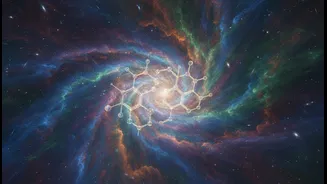
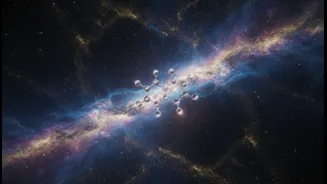
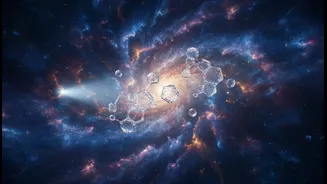
Before you imagine a cosmic candyfloss cloud, it’s important to know this isn’t the kind of sugar you stir into your coffee. Scientists have identified erythrulose, a four-carbon sugar that, on Earth, is found in things like raspberries. While simple
in chemical terms, this is a landmark find. For years, researchers have found other organic molecules in space, but this is the first definitive detection of a 'true' sugar in the interstellar medium—the thin veil of gas and dust between stars. Previous discoveries, like the two-carbon molecule glycolaldehyde found over two decades ago, were more like sugar relatives. Erythrulose is a more complex, substantial piece of the prebiotic puzzle, a molecule directly related to the chemistry that underpins life.
A Cosmic Cauldron
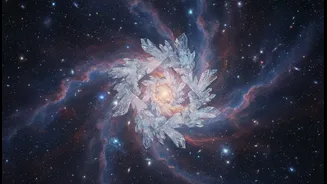
This sweet discovery was made in a particularly dramatic location: a dense molecular cloud named G+0.693-0.027. Located roughly 27,000 light-years away, this cloud is a neighbour to the supermassive black hole at the center of our Milky Way. These clouds are essentially stellar nurseries, vast, cold, and turbulent regions where new stars and planets are born. Finding a relatively complex molecule like erythrulose here is significant because it proves that the ingredients for life can form in the harsh, frigid conditions of deep space, long before they ever get a chance to land on a forming planet. It suggests these vital compounds are being cooked up in the cosmos and are available to be included in new solar systems as they take shape.
Listening for Molecules
You can't exactly send a probe 27,000 light-years away to take a sample. So how did scientists find it? The discovery was made using powerful radio telescopes in Spain. Every molecule, as it tumbles and vibrates in space, emits or absorbs energy at very specific frequencies. This creates a unique 'fingerprint' or 'barcode' in the radio spectrum. Astronomers can point a telescope at a cloud, collect the faint radio signals, and then match those signals to patterns of known molecules measured in a lab on Earth. In this case, an international team led by researchers from Spain's Centre for Astrobiology spent hours carefully analysing the data before they found the tell-tale signature of erythrulose shining through the cosmic noise.
The Recipe for Life
This discovery doesn’t mean we’ve found alien life. What it does mean is that one of life’s most essential ingredients is more common in the galaxy than we knew. Sugars, or carbohydrates, are fundamental to life as we know it. They form the structural backbone of RNA and DNA and are a primary source of metabolic energy. For a long time, scientists have wondered if these crucial molecules formed on early Earth or if they were delivered from space. Finding sugars in meteorites has long hinted at a cosmic origin, but detecting erythrulose freely floating in an interstellar cloud provides the strongest evidence yet for the 'seeding' hypothesis. This theory suggests that comets and asteroids, which form from these very clouds, could have delivered a payload of water and prebiotic molecules—including sugars—to a young Earth, providing the raw materials for life to begin.